English
 Español
 tiếng việt
 русский
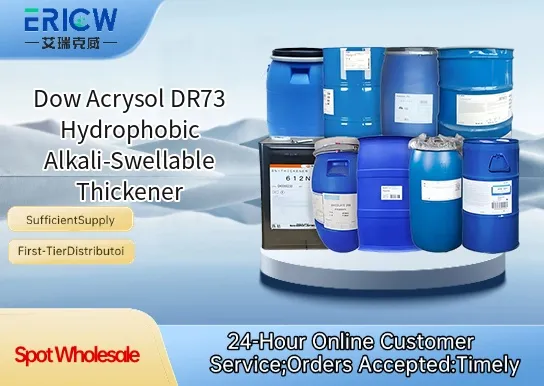
Delivers excellent viscosity build and rheology control in high-shear and low-shear conditions.
Provides superior sag resistance and anti-drip performance in architectural coatings.
Offers enhanced water resistance and film integrity due to hydrophobic polymer architecture.
Enables efficient thickening with low dosage and minimal impact on color development and gloss.
Compatible with a broad range of anionic and nonionic surfactants, co-thickeners, and biocides.
Interior and exterior latex architectural paints.
Textured coatings and decorative finishes.
Exterior masonry and stucco coatings.
Low-VOC and zero-VOC waterborne formulations.
Industrial maintenance coatings requiring robust film formation.
| Chemical Type | Hydrophobically modified alkali-swellable emulsion (HASE) |
| Product Form | Aqueous dispersion |
| Appearance | Opaque white liquid |
| pH (as received) | 2.5–4.0 |
| Active Content (wt%) | 28–32% |
| Viscosity (Brookfield, RVT, #2 spindle, 20 rpm, 25°C) | 1,000–3,000 cP |
| Freeze-Thaw Stability | Pass (3 cycles at –15°C/25°C) |
| Primary Applications | Architectural waterborne coatings, especially where water resistance and sag control are critical |
Q1: How does DR73 differ from conventional non-hydrophobic alkali-swellable thickeners?
A: DR73 features a hydrophobic modification that enhances associative thickening behavior, providing improved viscosity retention under high-shear conditions and greater resistance to electrolyte-induced thinning compared to non-hydrophobic counterparts. This results in better sag resistance and enhanced film-building performance in architectural coatings.
Q2: What is the recommended neutralization method for optimal performance?
A: DR73 should be neutralized with common alkaline agents such as ammonium hydroxide or sodium hydroxide—typically added post-dispersion and after pigment grinding—to achieve full viscosity development. Neutralization is best performed at pH 8.0–9.5, and the order of addition and mixing intensity significantly influence final rheology.
Q3: Can DR73 be used in low-VOC or zero-VOC formulations?
A: Yes, DR73 is compatible with low- and zero-VOC waterborne systems, including acrylic and vinyl-acrylic emulsions. Its low-odor profile and absence of volatile organic co-solvents support formulation compliance with stringent VOC regulations without compromising thickening efficiency.
Q4: How does DR73 perform in the presence of surfactants and co-thickeners?
A: DR73 exhibits good compatibility with anionic and nonionic surfactants commonly used in architectural paints, though excessive levels may suppress associative network formation. When combined with cellulosic or polyurethane thickeners, it contributes synergistic rheology—enhancing both low-shear viscosity and spatter resistance—provided addition sequence and dispersion protocols are carefully controlled.
Contact With Us:
E-mail: wangxingqiang@ericwchem.com
Have a Questions? Call Us:
Add:
Building A1, Jiete Industrial Park, Huangpu District, Guangzhou City, Guangdong Province, China