English
 Español
 tiếng việt
 русский
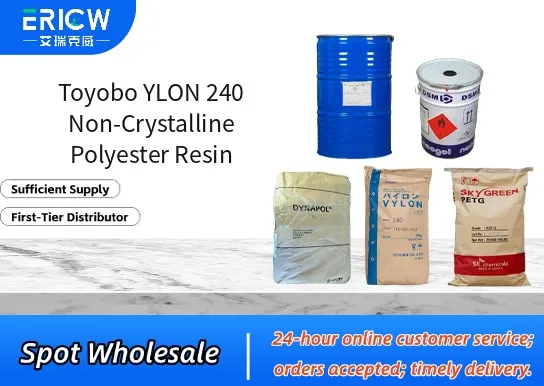
Non-crystalline structure ensures excellent clarity and optical uniformity in transparent coatings and films.
High solubility in common organic solvents enables easy formulation into solvent-based coating systems.
Low melt viscosity facilitates smooth processing during extrusion, casting, or hot-melt application.
Excellent thermal stability supports processing at elevated temperatures without premature degradation.
Good compatibility with acrylics, cellulose derivatives, and other thermoplastic resins for blended systems.
Optical-grade protective overcoats for display panels and touchscreens.
Transparent base resin for high-gloss decorative laminates and printed film substrates.
Binder component in specialty inkjet-receptive coatings for premium photo papers.
Adhesion-promoting interlayer in multi-material flexible packaging structures.
Clear topcoat resin for UV-curable hybrid systems requiring non-crystalline morphology.
| Chemical Type | Aliphatic non-crystalline polyester |
| Product Form | Pellets |
| Appearance | Translucent ivory-colored solid |
| Glass Transition Temperature (Tg) | 68–72 °C (DSC, 10 °C/min) |
| Melt Flow Index (MFI) | 8–12 g/10 min (230 °C, 2.16 kg) |
| Acid Value | 2–5 mg KOH/g |
| Hydroxyl Value | 12–18 mg KOH/g |
| Moisture Content | < 0.2 wt% (by Karl Fischer titration) |
Q1: What distinguishes YLON 240 from crystalline polyester resins?
A: YLON 240 is a non-crystalline (amorphous) polyester resin, offering superior clarity, uniform melt behavior, and enhanced compatibility with amorphous polymers such as PETG and polycarbonate—unlike crystalline polyesters, which may exhibit haze, inconsistent processing, or phase separation in transparent applications.
Q2: Is YLON 240 suitable for food-contact applications?
A: YLON 240 is designed for use in polymer modification where regulatory compliance is required; however, final food-contact suitability depends on the complete formulation, processing conditions, and applicable regional regulations. Users must conduct full regulatory evaluation—including migration testing—as part of their own compliance process.
Q3: How is YLON 240 typically incorporated into thermoplastic systems?
A: It is commonly introduced via dry blending followed by melt compounding—such as twin-screw extrusion—at temperatures compatible with the base polymer matrix. Due to its non-crystalline nature, it generally exhibits good dispersion and interfacial adhesion without requiring high-shear or extended residence time.
Q4: Does YLON 240 require drying before processing?
A: Yes—like many hygroscopic polyester materials, YLON 240 should be dried prior to melt processing to minimize hydrolytic degradation and maintain molecular weight integrity. Standard drying conditions (e.g., 120 °C for 4 hours under vacuum or low-dew-point air) are recommended, though optimal parameters should be confirmed based on ambient humidity and handling history.
Contact With Us:
E-mail: wangxingqiang@ericwchem.com
Have a Questions? Call Us:
Add:
Building A1, Jiete Industrial Park, Huangpu District, Guangzhou City, Guangdong Province, China