English
 Español
 tiếng việt
 русский
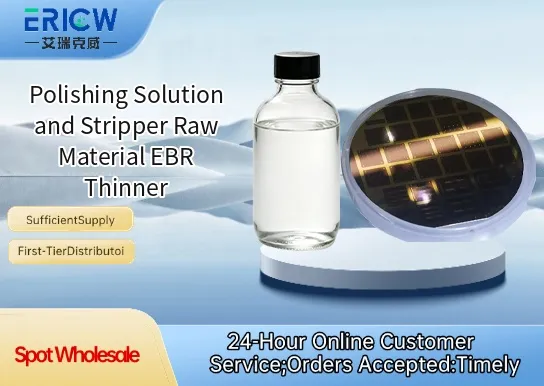
Highly effective solvent blend for rapid removal of photoresist, etch residues, and polishing by-products.
Low volatility and controlled evaporation rate to support consistent process window in precision cleaning steps.
Non-corrosive to common semiconductor metallization layers including Cu, Al, TiN, and low-k dielectrics.
Compatible with automated wet bench and spray rinse systems without foaming or residue formation.
Formulated with high-purity, ultra-low metal content (<10 ppb) to meet advanced node fab requirements.
Post-CMP (Chemical Mechanical Planarization) residue removal in advanced logic and memory device fabrication.
Photoresist stripping prior to metrology or inspection in 300 mm wafer processing lines.
Cleaning of polishing pads and carrier heads in CMP tool maintenance cycles.
Removal of organic contaminants from mask blanks and reticle handling components.
Pre-deposition surface conditioning for ALD and CVD chamber components.
| Chemical Type | Mixed organic solvent system (proprietary aprotic ester–ketone–alcohol blend) |
| Product Form | Liquid, ready-to-use |
| Appearance | Clear, colorless to pale yellow liquid |
| Density (25°C) | 0.92–0.96 g/cm³ |
| Flash Point (Tag Closed Cup) | 42–48°C |
| Primary Applications | Residue removal, photoresist stripping, post-CMP cleaning |
| Key Features | Non-halogenated, low surface tension (~24 mN/m), low particulate generation |
| Regulatory Compliance | REACH compliant; RoHS 2015/863 Annex II compliant; no SVHCs above threshold |
| Common Compatible Systems | Suitability |
| SEZ™ Wet Processing Tools (e.g., ZETA, AURA) | Highly Recommended – Validated for full-process integration with no hardware modification |
| Screen™ Spray Rinse Systems | Recommended – Requires minor nozzle calibration for optimal uniformity |
| TOKYO ELECTRON (TEL) CLEAN TRACK™ Platforms | Highly Recommended – Fully qualified per TEL Process Compatibility Bulletin #CB-EBR-2024 |
| DISCO™ DFP Series Debonding & Cleaning Units | Suitable – Effective for post-dicing residue removal; verify temperature setpoint alignment |
Q1: What is the CAS Registry Number for EBR Thinner?
A: The proprietary formulation does not have a single CAS number; individual major constituents include CAS 108-65-6 (methyl ethyl ketone), CAS 110-19-0 (cyclohexanone), and CAS 109-86-4 (ethyl acetate). Full composition disclosure is available under NDA.
Q2: What is the recommended usage concentration and temperature range?
A: Use as supplied (100% concentration); optimal operating temperature is 20–35°C. Elevated temperatures (>45°C) are not recommended due to accelerated solvent loss and potential residue redeposition.
Q3: How does EBR Thinner compare to traditional NMP-based strippers in terms of safety and performance?
A: Unlike NMP (CAS 872-50-4), EBR Thinner is non-reprotoxic, has lower dermal absorption risk, and eliminates occupational exposure concerns linked to NMP. Performance parity is maintained for sub-28 nm node resist stripping with improved compatibility on porous low-k films.
Q4: Are there extractables or leachables data available for contact with fluoropolymer (e.g., PFA, FEP) fluidic components?
A: Yes — validated extractables testing per USP <788> and SEMI F57 shows <0.5 ppm total organic leachables after 72 h static exposure at 30°C in PFA tubing. No fluorinated degradation products detected by GC-MS.
Q5: Does EBR Thinner require special ventilation or personal protective equipment (PPE) beyond standard cleanroom protocols?
A: Standard cleanroom PPE (nitrile gloves, safety goggles, lab coat) is sufficient. Local exhaust ventilation (LEV) with ≥60 ACH is recommended for bulk handling areas to maintain vapor concentration below 50% of OSHA PEL (200 ppm for MEK).
Contact With Us:
E-mail: wangxingqiang@ericwchem.com
Have a Questions? Call Us:
Add:
Building A1, Jiete Industrial Park, Huangpu District, Guangzhou City, Guangdong Province, China