English
 Español
 tiếng việt
 русский
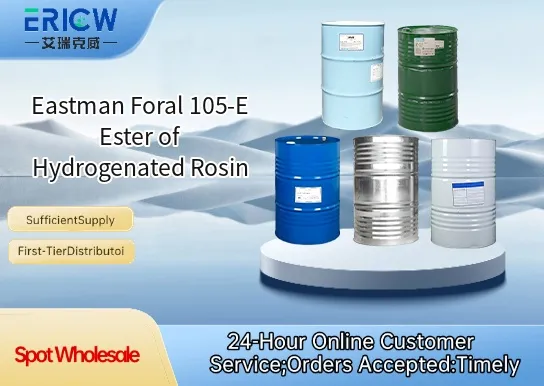
High thermal and oxidative stability due to complete hydrogenation of the rosin backbone.
Low color and excellent long-term clarity in transparent formulations.
Good compatibility with a wide range of polymers including acrylics, vinyls, and styrenics.
Low volatility and minimal odor, supporting use in sensitive applications such as adhesives and coatings.
Consistent performance and batch-to-batch reproducibility backed by Eastman’s stringent quality control.
Hot-melt adhesives for packaging, labeling, and assembly.
Pressure-sensitive adhesives in tapes, labels, and medical films.
Printing inks—especially flexographic and gravure inks requiring high gloss and rub resistance.
Coating resins for wood, paper, and metal where clarity and durability are critical.
Plastic modifiers for enhancing tack, adhesion, and melt flow in thermoplastic elastomer systems.
| Chemical Type | Ester of hydrogenated rosin (glycerol ester) |
| Product Form | Pale yellow to water-white solid pellets or flakes |
| Appearance | Clear, brittle, translucent solid at room temperature |
| Softening Point (Ring & Ball, ASTM E28) | 103–107 °C |
| Acid Number (ASTM D1639) | ≤ 10 mg KOH/g |
| Color (Gardner, ASTM D1544, 50% w/w in toluene) | ≤ 2 |
| Thermal Stability (Weight loss at 180 °C, 1 hr, ASTM D36) | < 0.5% weight loss |
| Solubility | Freely soluble in hydrocarbons, esters, ketones, and chlorinated solvents; insoluble in water |
Contact With Us:
E-mail: wangxingqiang@ericwchem.com
Have a Questions? Call Us:
Add:
Building A1, Jiete Industrial Park, Huangpu District, Guangzhou City, Guangdong Province, China