English
 Español
 tiếng việt
 русский
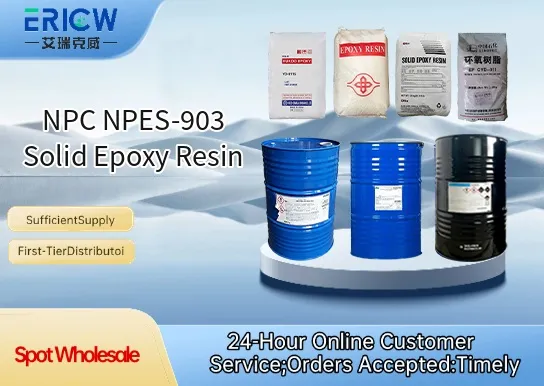
High purity solid epoxy resin with consistent molecular weight distribution.
Excellent thermal stability and low volatility for safe high-temperature processing.
Superior compatibility with common curing agents including amines and anhydrides.
Low chloride content (< 500 ppm) ensuring enhanced electrical insulation performance.
Free-flowing granular form enabling precise metering and uniform dispersion in compound formulations.
Electrical encapsulation compounds for power modules and high-voltage insulators.
High-performance powder coatings for automotive under-hood components.
Structural adhesives requiring elevated heat resistance and dimensional stability.
Prepregs and laminates in printed circuit board (PCB) base materials.
Composite matrices for aerospace and wind turbine blade applications.
| Chemical Type | Bisphenol-A based solid epoxy resin |
| Product Form | Free-flowing off-white granules |
| Appearance | Uniform granular solid, no visible impurities |
| Epoxy Equivalent Weight (EEW) | 470–490 g/eq |
| Melting Point | 85–92 °C |
| Softening Point | 80–86 °C |
| Chloride Content | ≤ 500 ppm |
| Volatiles (150 °C, 2 h) | ≤ 0.3 wt% |
Q1: What is the primary functional role of NPC NPES-903 in epoxy formulations?
A: NPC NPES-903 is a solid bisphenol-A-based epoxy resin designed primarily as a reactive binder and matrix former. It provides structural integrity, thermal stability, and chemical resistance when cured with suitable hardeners—commonly used in powder coatings, electrical encapsulants, and high-performance composites.
Q2: How does NPC NPES-903 differ from liquid epoxy resins in processing applications?
A: As a solid resin, NPC NPES-903 offers improved handling safety, reduced volatility, and enhanced storage stability compared to liquid counterparts. Its particulate or flake form facilitates uniform dry blending in powder coating systems and supports melt-mixing without solvent use—making it well-suited for eco-conscious manufacturing processes.
Q3: Which types of curing agents are typically compatible with NPC NPES-903?
A: NPC NPES-903 demonstrates good reactivity with common amine-based hardeners (e.g., dicyandiamide, aromatic amines), anhydrides, and phenolic novolacs. Optimal cure profiles depend on the selected hardener, thermal schedule, and end-use requirements—formulators are advised to conduct small-scale compatibility and gel time testing.
Q4: Is NPC NPES-903 suitable for food-contact or potable water applications?
A: NPC NPES-903 is not pre-qualified for direct food-contact or potable water applications. Its suitability for such uses depends entirely on full system formulation—including hardener, additives, and final cured properties—as well as compliance verification against relevant regional regulatory frameworks. End users must perform full regulatory due diligence prior to deployment.
Q5: What are key storage and handling recommendations for this solid resin?
A: Store NPC NPES-903 in a cool, dry place below 30 °C, protected from moisture and direct sunlight. Keep containers tightly sealed to prevent agglomeration or surface tackiness. Avoid prolonged exposure to high humidity during handling, and ensure equipment is clean and free of incompatible residues before use.
Contact With Us:
E-mail: wangxingqiang@ericwchem.com
Have a Questions? Call Us:
Add:
Building A1, Jiete Industrial Park, Huangpu District, Guangzhou City, Guangdong Province, China