English
 Español
 tiếng việt
 русский
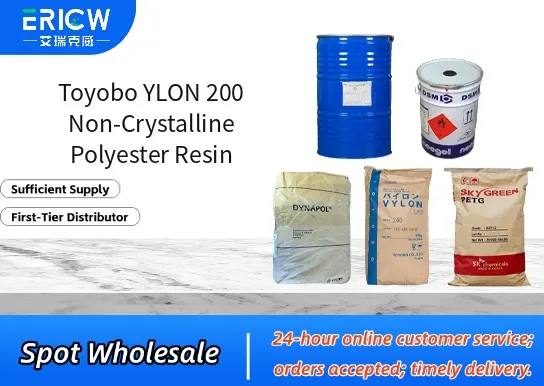
Non-crystalline molecular structure ensures excellent clarity and optical uniformity in final products.
High compatibility with plasticizers and other polyester-based resins enables versatile formulation flexibility.
Superior thermal stability supports processing at elevated temperatures without premature degradation.
Low melt viscosity facilitates easy extrusion, film casting, and coating applications.
Hydrolysis-resistant backbone enhances long-term durability in humid or moisture-prone environments.
Optical films for display protection and touch panel laminates.
High-clarity packaging films requiring gloss retention and dimensional stability.
Adhesive primers and tie layers in multilayer coextruded structures.
Base resin for specialty coatings on rigid substrates including PET and polycarbonate.
Electronics encapsulation materials demanding low birefringence and UV stability.
| Chemical Type | Aliphatic-aromatic non-crystalline polyester |
| Product Form | Pellets |
| Appearance | Translucent, off-white pellets |
| Glass Transition Temperature (Tg) | 78–82 °C (DSC, 10 °C/min) |
| Melt Flow Index (MFI) | 12–16 g/10 min (230 °C / 2.16 kg) |
| Moisture Content | ≤ 0.2 wt% (as received) |
| Primary Applications | Optical films, high-clarity packaging, functional coatings, multilayer laminates |
| Key Features | Non-crystalline, hydrolysis-resistant, low birefringence, excellent melt processability |
Q1: What is the primary functional role of YLON 200 in coating and ink formulations?
A: YLON 200 functions primarily as a non-crystalline polyester resin modifier that enhances film flexibility, improves substrate adhesion, and contributes to balanced hardness–toughness performance without compromising clarity or gloss retention.
Q2: Is YLON 200 compatible with common solvent-based and UV-curable systems?
A: Yes — YLON 200 exhibits broad compatibility with conventional solvent-borne acrylics, alkyds, and epoxy resins, and can also be incorporated into selected UV-curable acrylate blends where thermal stability and low crystallinity are advantageous during formulation and curing.
Q3: How does the non-crystalline nature of YLON 200 benefit end-use performance?
A: Its non-crystalline structure ensures consistent solubility across diverse solvent systems, eliminates haze or bloom risks in clear coatings, and supports uniform film formation—particularly important for high-gloss decorative and protective applications requiring optical clarity and long-term dimensional stability.
Q4: What handling or storage precautions should be observed for YLON 200?
A: Store in a cool, dry location away from direct sunlight and sources of heat. Keep containers tightly sealed to prevent moisture absorption and maintain resin integrity. Avoid prolonged exposure to ambient humidity during handling, especially in high-humidity environments.
Contact With Us:
E-mail: wangxingqiang@ericwchem.com
Have a Questions? Call Us:
Add:
Building A1, Jiete Industrial Park, Huangpu District, Guangzhou City, Guangdong Province, China