English
 Español
 tiếng việt
 русский
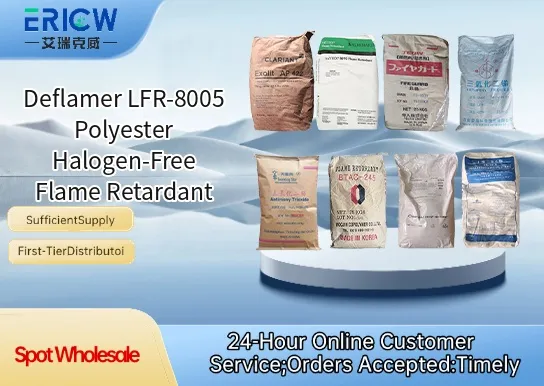
Phosphorus-nitrogen synergistic system enabling excellent flame retardancy without halogenated compounds.
Designed specifically for polyester (PET, PBT) matrices with high compatibility and minimal impact on mechanical properties.
Low smoke density and negligible toxic gas emission during combustion—meets UL 94 V-0 at ≥1.6 mm thickness.
Good thermal stability up to 300 °C, supporting standard melt-processing conditions including extrusion and injection molding.
Non-migrating formulation ensures long-term flame-retardant performance and surface integrity.
Electrical & electronics housings (e.g., connectors, switches, terminal blocks).
Automotive interior components (e.g., trim panels, air ducts, sensor housings).
Textile fibers and spunbond nonwovens requiring flame-resistant PET staple fiber.
3C product enclosures complying with IEC 60695 and RoHS/REACH requirements.
Industrial conveyor belts and technical fabrics where low-smoke, halogen-free performance is mandated.
| Chemical Type | Organophosphorus-nitrogen condensed additive |
| Product Form | Free-flowing white granules |
| Appearance | Off-white to light beige granules, uniform size distribution |
| Primary Applications | Polyester (PET, PBT), copolyesters, and PET-based blends |
| Key Features | Halogen-free, phosphorus-based, UL 94 V-0 compliant (1.6 mm) |
| Benefits | Low smoke, no corrosive gases, excellent processability, recyclable |
| Density | 1.45–1.55 g/cm³ |
| Recommended Loading Level | 12–18 wt% in PET matrix (varies by grade and end-use requirement) |
Q1: What types of polyester resins is Deflamer LFR-8005 compatible with?
A: Deflamer LFR-8005 is specifically engineered for use in unsaturated polyester (UP) resins and modified polyester systems, including those used in sheet molding compound (SMC), bulk molding compound (BMC), and gel coats. It demonstrates good compatibility and dispersion stability without significantly affecting resin viscosity or cure kinetics.
Q2: How does LFR-8005 achieve flame retardancy without halogens?
A: LFR-8005 operates primarily through an intumescent mechanism, promoting the formation of a thermally stable, insulating char layer upon exposure to heat. Its phosphorus- and nitrogen-based chemistry supports gas-phase radical quenching and condensed-phase charring, delivering effective flame suppression while avoiding corrosive halogenated decomposition products.
Q3: Does LFR-8005 impact mechanical properties or surface finish of cured composites?
A: When properly dispersed and dosed within recommended ranges, LFR-8005 typically maintains good retention of tensile strength, flexural modulus, and surface gloss. Minor reductions in impact resistance may occur at higher loadings, so optimization with the base formulation is advised to balance flame performance and physical properties.
Q4: Is LFR-8005 suitable for applications requiring low smoke and low toxicity during fire exposure?
A: Yes — as a halogen-free system, LFR-8005 produces significantly lower smoke density and reduced emission of toxic gases (e.g., hydrogen halides, dioxins) compared to brominated or chlorinated flame retardants, making it well-suited for transportation, building, and electronics enclosures where fire safety and indoor air quality are critical.
Q5: What is the typical dosage range for achieving UL 94 V-0 or equivalent fire performance?
A: Effective dosage generally ranges from 0.1% to 2% by weight relative to the total resin system, depending on resin composition, filler content, part thickness, and target fire classification. Optimization trials are recommended to determine the minimum effective level for specific formulations and end-use requirements.
Contact With Us:
E-mail: wangxingqiang@ericwchem.com
Have a Questions? Call Us:
Add:
Building A1, Jiete Industrial Park, Huangpu District, Guangzhou City, Guangdong Province, China