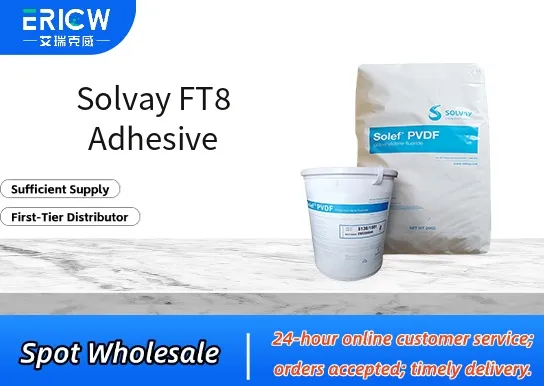
Features Of Solvay FT8 Adhesive
High-performance thermoplastic adhesive based on polyamide chemistry for demanding bonding environments.
Excellent resistance to hydrocarbons, oils, and common industrial solvents at elevated temperatures.
Fast melt processing with narrow softening range (175–185 °C), enabling precise application in extrusion and hot-melt coating lines.
Outstanding adhesion to polyolefins, metals, and engineered thermoplastics without primer or surface pretreatment.
UL 94 HB rated for flammability; complies with RoHS and REACH regulatory requirements.
Typical Applications Of Solvay FT8 Adhesive
Aerospace interior bonding: attachment of trim panels, insulation blankets, and composite overlays.
Automotive under-hood components: sensor housings, fluid reservoirs, and heat-shield assemblies.
Industrial filtration media lamination: bonding pleated nonwovens to polymer frames and support structures.
Medical device assembly: secure, biocompatibility-compatible bonding of thermoplastic housings and fluidic manifolds.
Electronics encapsulation and potting: structural reinforcement of connectors and power modules exposed to thermal cycling.
Specifications Of Solvay FT8 Adhesive
| Chemical Type | Polyamide-based thermoplastic adhesive |
| Product Form | Pellets (cylindrical, ~3 mm diameter) |
| Appearance | Off-white to light tan, free-flowing granules |
| Melt Flow Rate (190 °C / 2.16 kg) | 12–16 g/10 min |
| Softening Point (ASTM E28) | 178–183 °C |
| Density (23 °C) | 1.03–1.06 g/cm³ |
| Primary Applications | Hot-melt lamination, extrusion coating, and injection overmolding |
| Key Features | Solvent-free, low volatility, reworkable before full crystallization |
Solvay FT8 Adhesive – Frequently Asked Questions (FAQ)
Q1: What is Solvay FT8 Adhesive primarily used for?
A: Solvay FT8 Adhesive is a high-performance, thermally stable adhesive system designed for bonding advanced composite components in demanding aerospace and industrial applications, particularly where resistance to elevated temperatures and long-term durability under mechanical stress are required.
Q2: Is Solvay FT8 Adhesive compatible with common composite substrates?
A: Yes — it demonstrates excellent adhesion to carbon fiber-reinforced polymers (CFRP), fiberglass, aluminum alloys, and titanium surfaces. Surface preparation (e.g., solvent cleaning and light abrasion) is recommended to optimize bond strength and longevity.
Q3: What is the typical cure profile for Solvay FT8 Adhesive?
A: It is formulated for elevated-temperature curing, generally requiring a controlled thermal cycle — typically involving ramping to and holding at an intermediate temperature followed by a higher final cure stage. Exact parameters depend on part geometry, tooling, and production requirements, and should be validated per application-specific qualification protocols.
Q4: How should Solvay FT8 Adhesive be stored and handled?
A: Store unopened containers in a cool, dry place away from direct sunlight and heat sources. Once opened, maintain strict moisture control and follow recommended shelf-life guidelines. Use appropriate personal protective equipment (PPE), including nitrile gloves and eye protection, during handling due to its reactive chemistry.
 English
 Español
 tiếng việt
 русский