English
 Español
 tiếng việt
 русский
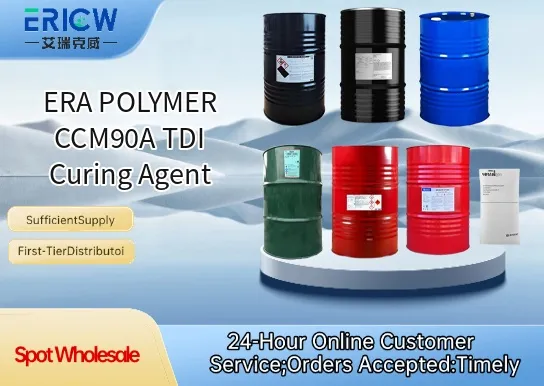
High reactivity with hydroxyl-terminated polyether and polyester prepolymers.
Excellent compatibility with common polyurethane resin systems.
Delivers superior mechanical strength and abrasion resistance in cured elastomers.
Low viscosity for easy metering, mixing, and processing at ambient temperatures.
Consistent batch-to-batch performance ensured through strict quality control.
Cast polyurethane elastomer components for mining and material handling equipment.
Roller covers and industrial wheels requiring high load-bearing capacity.
Seals, gaskets, and hydraulic system components exposed to dynamic stress.
Automotive suspension bushings and vibration-damping mounts.
Adhesives and coatings requiring rapid green strength development.
| Chemical Type | TDI-based aromatic curing agent (modified 2,4-TDI adduct) |
| Product Form | Liquid |
| Appearance | Clear to pale yellow transparent liquid |
| Viscosity (25°C) | 1,200–1,800 cP |
| Active Hydrogen Equivalent Weight | Approx. 135 g/eq |
| Functionality | ~2.0–2.2 (average active H per molecule) |
| Storage Stability | ≥6 months at 15–25°C in sealed container under dry nitrogen |
| Primary Applications | Casting, reaction injection molding (RIM), and prepolymer-based PU elastomers |
Q1: What is the primary chemical functionality of CCM90A?
A: CCM90A is a polymeric toluene diisocyanate (TDI)-based curing agent, featuring reactive isocyanate (–NCO) groups that enable crosslinking with hydroxyl-terminated resins such as polyols and polyacrylates in two-component systems.
Q2: Is CCM90A suitable for flexible or rigid coating applications?
A: Yes — its polymeric TDI structure provides a balanced combination of reactivity, film toughness, and flexibility, making it well-suited for both semi-rigid industrial coatings and moderately flexible elastomeric systems, depending on the resin selection and NCO:OH ratio.
Q3: How should CCM90A be stored to maintain stability and performance?
A: Store in tightly sealed containers under dry, cool conditions (below 30 °C), protected from moisture, direct sunlight, and ambient humidity. Prolonged exposure to air or moisture may cause surface skinning or viscosity increase due to premature reaction with water.
Q4: Can CCM90A be used with polyester or acrylic polyol resins?
A: Yes — CCM90A demonstrates broad compatibility with common hydroxyl-functional polyester, acrylic, and polyether polyols. Optimal cure profiles and final film properties depend on resin molecular weight, hydroxyl value, and formulation solids content.
Q5: What is the typical dosage range for CCM90A in standard two-component formulations?
A: Dosage depends on the target NCO:OH equivalence ratio and desired film properties, but CCM90A is typically used at low concentrations — generally ranging from 0.1% to 2% by weight relative to the total formulation, adjusted to achieve full crosslink density without excessive brittleness.
Contact With Us:
E-mail: wangxingqiang@ericwchem.com
Have a Questions? Call Us:
Add:
Building A1, Jiete Industrial Park, Huangpu District, Guangzhou City, Guangdong Province, China