English
 Español
 tiếng việt
 русский
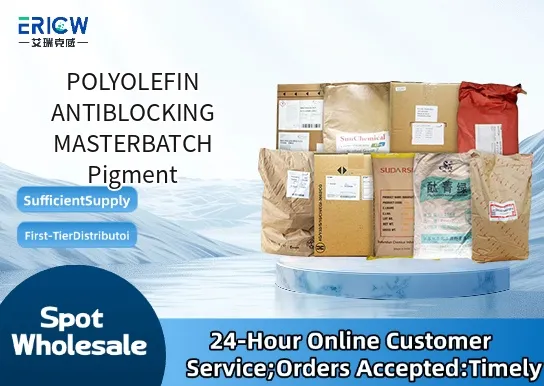
Highly effective silica-based antiblocking agent dispersed in polyolefin carrier for uniform distribution.
Simultaneously delivers controlled surface roughness and consistent pigment coloration in one masterbatch system.
Thermally stable up to 280°C, ensuring compatibility with high-speed extrusion and blow molding processes.
Low-dust, free-flowing granules for safe handling and precise gravimetric dosing in automated feeding systems.
Non-migrating formulation prevents bloom or haze development during long-term storage and end-use conditions.
Blown and cast polyethylene (LDPE, LLDPE, HDPE) films for packaging and agricultural use.
Polypropylene (PP) biaxially oriented films (BOPP) requiring optical clarity and anti-sticking performance.
Injection-molded PP and PE containers, caps, and closures where surface tack resistance is critical.
Extruded PE/PP monolayer and multilayer barrier films for food, medical, and industrial packaging.
| Chemical Type | Silica-based antiblocking agent + organic pigment in polyolefin carrier |
| Product Form | Free-flowing cylindrical granules |
| Appearance | Uniform colored granules, no dust or agglomerates |
| Carrier Resin | LDPE or PP (customizable per customer requirement) |
| Typical Loading | 1–5 wt% depending on film thickness and processing conditions |
| Key Features | Antiblocking + pigment dispersion in single additive system |
| Benefits | Reduces film blocking, improves winding efficiency, enhances color consistency |
| Storage Conditions | Store in dry, cool, well-ventilated area; keep sealed to prevent moisture absorption |
Q1: What is the primary function of this masterbatch in polyolefin processing?
A: This masterbatch is specifically engineered to prevent surface blocking—i.e., unwanted adhesion between layers—of polyolefin films and sheets during winding, storage, or conversion. It achieves this by introducing finely dispersed inorganic antiblocking agents (e.g., silica or calcium carbonate) along with compatible pigment carriers that ensure uniform distribution without compromising optical clarity or mechanical integrity.
Q2: Can this masterbatch be used in food-contact polyolefin applications?
A: Yes, subject to compliance with applicable regional food-contact regulations. The formulation uses FDA-acknowledged or EFSA-permitted raw materials where applicable, and all components are selected for low volatility and minimal extractables. Final regulatory suitability must be verified based on the end-use conditions, processing parameters, and finished article specifications.
Q3: How does pigment compatibility affect performance in colored polyolefin films?
A: The pigment system is pre-dispersed and stabilized within a polyolefin-compatible carrier resin, ensuring excellent dispersion stability and avoiding pigment agglomeration or re-aggregation during high-shear extrusion or blow molding. This minimizes color streaking while maintaining consistent antiblocking efficacy across pigmented formulations—including white, black, and custom color grades.
Q4: What is the typical dosage range for optimal antiblocking performance?
A: Dosage depends on film thickness, polymer type (e.g., LDPE vs. PP), processing conditions, and required surface slip level. It is generally used at low concentrations—typically ranging from 0.1% to 2% by weight—and should be optimized through lab-scale trials to balance performance, cost, and downstream process stability.
Contact With Us:
E-mail: wangxingqiang@ericwchem.com
Have a Questions? Call Us:
Add:
Building A1, Jiete Industrial Park, Huangpu District, Guangzhou City, Guangdong Province, China