English
 Español
 tiếng việt
 русский
Excellent abrasion resistance for extended service life in demanding mechanical environments.
High tensile strength and elongation at break, enabling reliable performance under dynamic stress.
Good low-temperature flexibility down to –30 °C without significant loss of elasticity.
Outstanding resistance to oils, greases, and many common industrial chemicals.
Processable via standard thermoplastic methods including injection molding, extrusion, and blow molding.
Automotive interior trim components requiring soft-touch feel and durability.
Industrial hoses and tubing exposed to hydraulic fluids and intermittent flexing.
Protective covers and gaskets for electronic enclosures and portable equipment.
Footwear midsoles and outsoles demanding resilience and energy return.
Conveyor belts and wear strips in material handling systems.
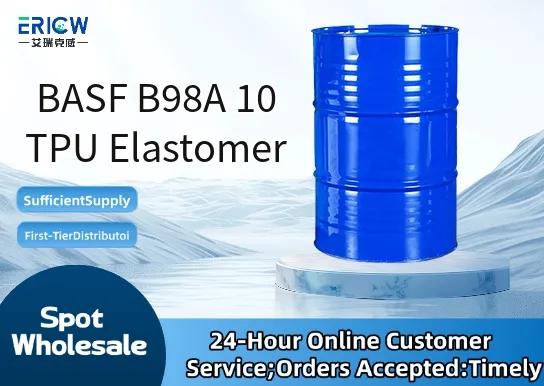
| Chemical Type | Thermoplastic Polyurethane (TPU), polyester-based |
| Product Form | Pellets |
| Appearance | Off-white to light beige, free-flowing granules |
| Primary Applications | Dynamic mechanical parts, protective components, flexible profiles |
| Key Features | High elasticity, oil resistance, processability, low-temperature flexibility |
| Benefits | Reduced part wear, design freedom for complex geometries, recyclability as thermoplastic |
| Processing Temperature Range | 180–220 °C (recommended melt temperature) |
| Density (ISO 1183) | Approx. 1.20 g/cm³ |
Q1: What is the primary functional role of BASF B98A 10 in TPU formulations?
A: BASF B98A 10 is a thermoplastic polyurethane (TPU) elastomer designed to enhance melt processability, improve surface finish, and provide balanced mechanical performance—particularly elasticity, abrasion resistance, and low-temperature flexibility—in extruded or injection-molded TPU parts.
Q2: Is BASF B98A 10 compatible with other TPU grades or polymer blends?
A: Yes, B98A 10 exhibits good compatibility with aromatic and aliphatic TPU resins, as well as certain engineering thermoplastics such as PC and ABS when used in alloy systems—though compatibility should be verified experimentally for each specific formulation and processing condition.
Q3: What are the recommended drying conditions prior to processing?
A: To ensure optimal melt stability and mechanical properties, B98A 10 should be dried thoroughly before processing—typically at 70–80 °C for 3–4 hours using a dehumidifying dryer, as residual moisture can lead to surface defects and molecular weight degradation during melt processing.
Q4: Can BASF B98A 10 be used in applications requiring regulatory compliance for food contact or medical devices?
A: B98A 10 is not pre-certified for food-contact or medical applications; its suitability for such uses depends on final formulation, processing history, and end-product testing against applicable regional requirements—customers must conduct full regulatory validation including extractables/leachables assessment where required.
Contact With Us:
E-mail: wangxingqiang@ericwchem.com
Have a Questions? Call Us:
Add:
Building A1, Jiete Industrial Park, Huangpu District, Guangzhou City, Guangdong Province, China