English
 Español
 tiếng việt
 русский
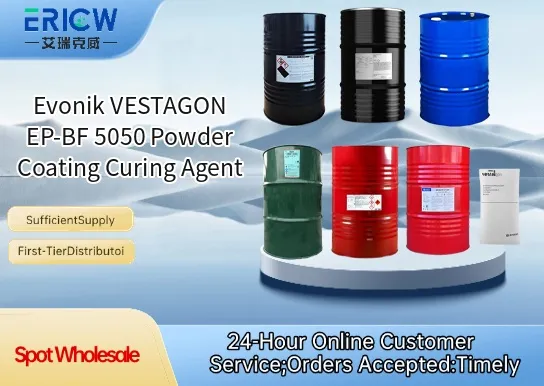
High reactivity with epoxy resins enabling rapid cure at low temperatures (140–160 °C).
Excellent storage stability as a free-flowing, non-hygroscopic powder.
Low volatility and negligible odor — supports safe handling and compliant VOC-free formulations.
Consistent performance across diverse epoxy resin systems, including standard DGEBA and novolac types.
Enables high-gloss, smooth finishes with superior mechanical and chemical resistance in cured coatings.
Appliance coatings for refrigerators, ovens, and washing machines.
Architectural metal finishes for façades, window frames, and cladding systems.
Automotive under-hood components requiring thermal and chemical durability.
Office furniture and shelving systems demanding aesthetic quality and scratch resistance.
Industrial equipment housings exposed to mild corrosion and mechanical wear.
| Chemical Type | Modified imidazole derivative |
| Product Form | Free-flowing white to off-white powder |
| Appearance | Homogeneous fine powder, no lumps or agglomerates |
| Primary Applications | Epoxy-based thermoset powder coatings |
| Key Features | Low-cure, high-reactivity, VOC-free, non-halogenated |
| Benefits | Energy-efficient curing, excellent film formation, long pot life in blends |
| Recommended Storage | Below 25 °C in original sealed packaging; protect from moisture |
| Shelf Life | 12 months under recommended storage conditions |
Q1: What is the primary function of VESTAGON EP-BF 5050 in powder coating formulations?
A: VESTAGON EP-BF 5050 is a highly reactive, low-bloom benzoxazine-based curing agent designed to crosslink epoxy resins in thermosetting powder coatings. It enables rapid cure at moderate temperatures while supporting excellent storage stability and film appearance.
Q2: How does EP-BF 5050 compare to conventional dicyandiamide (DICY) or phenolic curing agents?
A: Unlike DICY, EP-BF 5050 offers improved compatibility with standard epoxy resins, reduced risk of blooming, and enhanced reactivity without requiring latency promoters. Compared to phenolics, it delivers lower odor, better yellowing resistance, and more consistent flow and leveling—particularly in thin-film and high-gloss applications.
Q3: Is EP-BF 5050 suitable for outdoor durable powder coatings?
A: Yes—when formulated with appropriate epoxy resins and stabilizers, systems containing EP-BF 5050 demonstrate good UV stability and weather resistance. Its low volatility and robust crosslink density contribute to long-term performance in architectural and industrial exterior applications.
Q4: What are the recommended storage conditions for EP-BF 5050 powder?
A: Store in original sealed packaging under cool, dry conditions (below 25 °C) and protect from moisture and direct sunlight. Prolonged exposure to humidity may affect flow behavior and reactivity due to its reactive nature.
Q5: Can EP-BF 5050 be used in hybrid (epoxy-polyester) powder systems?
A: While primarily optimized for pure epoxy and epoxy-acrylic systems, EP-BF 5050 can be incorporated into selected hybrid formulations—however, compatibility, cure response, and final properties must be verified experimentally, as co-cure kinetics with polyester resins vary significantly across resin grades and catalysts.
Contact With Us:
E-mail: wangxingqiang@ericwchem.com
Have a Questions? Call Us:
Add:
Building A1, Jiete Industrial Park, Huangpu District, Guangzhou City, Guangdong Province, China