English
 Español
 tiếng việt
 русский
Excellent abrasion resistance for demanding mechanical service life.
Good low-temperature flexibility down to –30 °C.
High transparency and excellent optical clarity in thin-section applications.
Hydrolysis-resistant formulation suitable for humid or wet environments.
Easy processability via injection molding and extrusion with narrow melt viscosity window.
Medical tubing and fluid handling components requiring biocompatibility support.
Transparent protective films and overlays for electronic displays.
Soft-touch grips and ergonomic overmolded parts for consumer electronics.
Seals and gaskets in automotive interior systems.
Flexible connectors and cable jacketing in industrial automation.
| Chemical Type | Aliphatic polyester-based thermoplastic polyurethane (TPU) |
| Product Form | Pellets |
| Appearance | Translucent, natural-colored granules |
| Primary Applications | Medical devices, optical components, soft-touch overmolding |
| Key Features | Hydrolysis resistance, UV stability, low extractables |
| Processing Methods | Injection molding, extrusion, blow molding |
| Compliance | USP Class VI compliant (per BASF internal testing), ISO 10993-5 ready |
| Storage Recommendation | Store in dry conditions at <25 °C; pre-dry before processing if RH >40% |
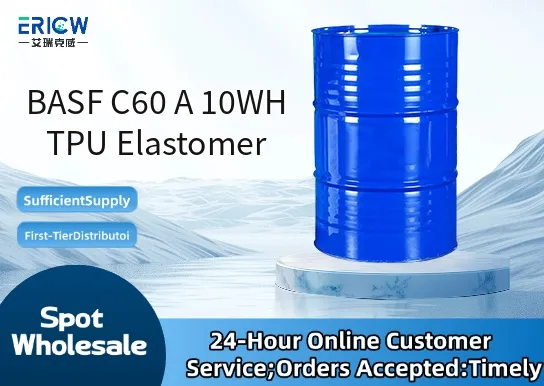
Q1: What is the primary function of BASF C60 A 10WH in TPU formulations?
A: BASF C60 A 10WH is a hydrolysis-stabilizing additive specifically designed to enhance the long-term durability of thermoplastic polyurethane (TPU) elastomers exposed to humid or elevated-temperature conditions. It functions by scavenging acidic degradation products formed during hydrolytic cleavage of urethane bonds.
Q2: Is C60 A 10WH compatible with all common TPU chemistries (e.g., polyester-, polyether-, and polycaprolactone-based)?
A: Yes, C60 A 10WH demonstrates broad compatibility across major TPU base chemistries. It is particularly effective in polyester-based TPUs, which are most susceptible to hydrolysis, but also provides measurable stabilization benefits in polyether and polycaprolactone variants when processing or end-use conditions involve moisture exposure.
Q3: How is C60 A 10WH typically incorporated into TPU compounds?
A: It is commonly added during compounding—either as a masterbatch or directly in powder form—using standard melt-processing equipment such as twin-screw extruders. Good dispersion is achieved under typical TPU processing temperatures (170–220 °C), and no pre-drying of the additive is required prior to use.
Q4: Does C60 A 10WH affect the mechanical or optical properties of the final TPU product?
A: At recommended dosage levels, C60 A 10WH has minimal impact on tensile strength, elongation, hardness, or clarity. It is formulated to deliver stabilization without compromising key performance attributes—making it suitable for demanding applications such as transparent films, medical tubing, or high-gloss automotive trim.
Contact With Us:
E-mail: wangxingqiang@ericwchem.com
Have a Questions? Call Us:
Add:
Building A1, Jiete Industrial Park, Huangpu District, Guangzhou City, Guangdong Province, China