English
 Español
 tiếng việt
 русский
High reactivity with amine and anhydride curing agents for rapid gelation and short cycle times.
Excellent adhesion to metals, composites, and cured epoxy substrates without surface priming.
Low viscosity (12,000–14,000 cP at 25°C) enabling easy processing via impregnation, casting, and resin transfer molding.
Superior electrical insulation properties with high dielectric strength and volume resistivity.
Good thermal stability with glass transition temperature (Tg) of 125–135°C after full cure with standard diamines.
Electrical encapsulation and potting of transformers, reactors, and high-voltage insulators.
Structural adhesive formulations for aerospace composite bonding and automotive metal-to-composite joints.
Matrix resin for filament-wound pressure vessels and fiber-reinforced pipes in chemical process industries.
Base resin for high-performance laminates used in printed circuit board (PCB) prepregs and copper-clad laminates.
Tooling and mold-making resins requiring dimensional stability and low exotherm during thick-section casting.
| Chemical Type | Diglycidyl ether of bisphenol-F (DGEBF) |
| Product Form | Liquid resin |
| Appearance | Pale yellow, transparent liquid |
| Epoxy Equivalent Weight (EEW) | 175–185 g/eq |
| Viscosity (25°C) | 12,000–14,000 cP |
| Chloride Content | ≤ 500 ppm |
| Volatiles Content | ≤ 0.3 wt% |
| Storage Stability | 12 months at ≤ 25°C in sealed original packaging |
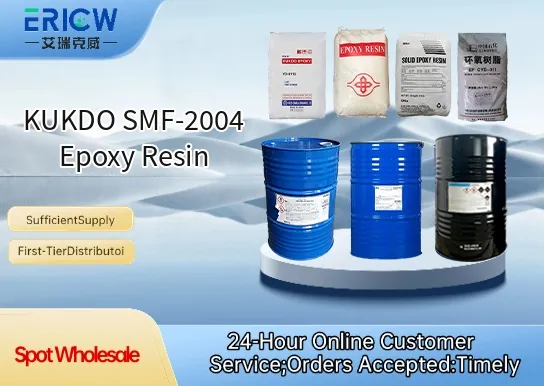
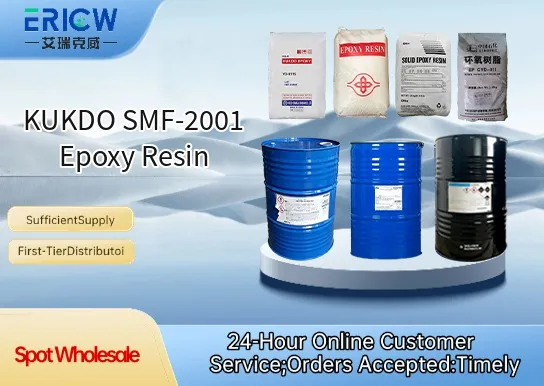
Q1: What is the primary functional role of KUKDO SMF-2001 in epoxy formulations?
A: KUKDO SMF-2001 is a solid multifunctional epoxy resin designed to serve as a reactive modifier or co-resin—enhancing crosslink density, thermal stability, and chemical resistance without significantly increasing viscosity during processing.
Q2: Is SMF-2001 suitable for high-gloss, low-VOC coating systems?
A: Yes—it is commonly selected for high-performance industrial coatings where reduced volatile organic content and improved film integrity are required. Its solid form supports solvent-free or low-solvent formulations while maintaining good flow and leveling characteristics.
Q3: How does SMF-2001 compare to standard DGEBA resins in terms of reactivity with common amine hardeners?
A: SMF-2001 exhibits moderate to high reactivity due to its higher epoxide functionality, often resulting in faster gel times and elevated glass transition temperatures in cured networks—though exact cure profiles depend on hardener selection and thermal schedule.
Q4: Can SMF-2001 be used in powder coating applications?
A: Yes—it is well-suited for thermosetting powder coatings owing to its solid state, narrow particle size distribution (when milled), and compatibility with standard curing agents such as TGIC or HAA derivatives.
Q5: What handling precautions should be observed during storage and processing?
A: Store in a cool, dry place away from direct sunlight and moisture. Due to its solid nature, avoid prolonged exposure to elevated ambient temperatures that may cause partial sintering; use appropriate personal protective equipment when handling fine particulate forms to minimize inhalation risk.
Contact With Us:
E-mail: wangxingqiang@ericwchem.com
Have a Questions? Call Us:
Add:
Building A1, Jiete Industrial Park, Huangpu District, Guangzhou City, Guangdong Province, China