English
 Español
 tiếng việt
 русский
Excellent abrasion resistance for extended service life in demanding mechanical environments.
Good low-temperature flexibility down to –30 °C, maintaining elasticity and impact resilience.
High tensile strength and elongation at break, enabling robust performance under dynamic stress.
Outstanding oil and grease resistance, suitable for contact with hydrocarbon-based lubricants.
Processable via standard thermoplastic methods including extrusion, injection molding, and calendering.
Automotive interior trim components such as instrument panel skins and door armrests.
Industrial hoses and tubing requiring flexibility, kink resistance, and chemical compatibility.
Footwear midsoles and outsoles where energy return and wear resistance are critical.
Conveyor belts and scraper blades in material handling systems.
Medical device housings and non-implantable wearable components requiring biocompatibility support.
| Chemical Type | Thermoplastic Polyurethane (TPU), Polyester-based |
| Product Form | Pellets |
| Appearance | Off-white to light beige granules |
| Hardness (Shore A) | 45–60 |
| Melt Flow Index (2.16 kg, 200 °C) | 25 g/10 min |
| Density | 1.18–1.22 g/cm³ |
| Processing Temperature Range | 180–220 °C |
| Key Features | High elasticity, excellent tear strength, good UV stability (with additive package) |
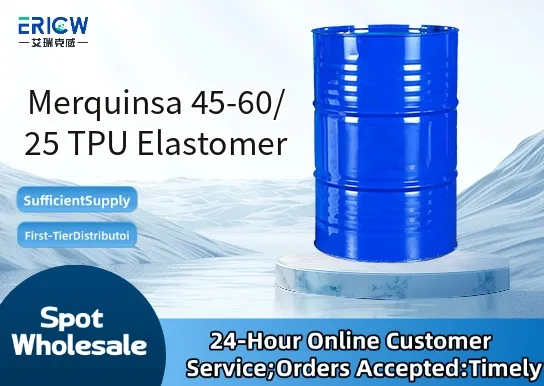
Q1: What is the primary application domain for Merquinsa 45-60/25 TPU Elastomer?
A: Merquinsa 45-60/25 is a thermoplastic polyurethane elastomer specifically engineered for demanding extrusion and injection molding applications, including flexible tubing, technical profiles, and high-resilience automotive interior components where consistent melt stability and excellent abrasion resistance are required.
Q2: How does this grade differ from standard aromatic TPU elastomers in terms of processing behavior?
A: Unlike conventional aromatic TPUs, Merquinsa 45-60/25 features a tailored molecular architecture that delivers enhanced thermal stability during melt processing—reducing yellowing and viscosity drift at elevated barrel temperatures—while maintaining good flow characteristics for thin-walled or complex geometries.
Q3: Is Merquinsa 45-60/25 suitable for applications requiring long-term UV exposure?
A: This grade is not inherently UV-stabilized; prolonged direct UV exposure may lead to surface discoloration and gradual reduction in mechanical performance. For outdoor or UV-intensive applications, integration of appropriate HALS-based stabilizers and/or protective topcoats is strongly recommended.
Q4: Can it be blended with other polymers such as PVC or polyolefins?
A: Merquinsa 45-60/25 exhibits limited compatibility with non-polar polymers like polyolefins due to polarity mismatch; however, it can be compatibilized in controlled blends with certain plasticized PVC systems—typically requiring careful optimization of shear history and additive selection to ensure phase dispersion and interfacial adhesion.
Contact With Us:
E-mail: wangxingqiang@ericwchem.com
Have a Questions? Call Us:
Add:
Building A1, Jiete Industrial Park, Huangpu District, Guangzhou City, Guangdong Province, China