English
 Español
 tiếng việt
 русский
High hydroxyl functionality for excellent crosslinking efficiency with melamine and polyisocyanate curing agents.
Outstanding weather resistance and UV stability, ensuring long-term gloss retention and color fidelity.
Low viscosity at high solids content (≥75% w/w), enabling reduced solvent usage and improved VOC compliance.
Excellent compatibility with common acrylics, polyesters, and cellulose esters in multi-resin coating systems.
Consistent batch-to-batch reproducibility supported by rigorous in-process QC and GMP-aligned manufacturing.
Automotive OEM and refinish topcoats requiring high hardness and chip resistance.
Industrial maintenance coatings for metal substrates in architectural and agricultural equipment.
General-purpose coil coatings where flexibility, corrosion resistance, and bake performance are critical.
Powder coating hybrid systems leveraging hydroxyl functionality for enhanced flow and edge coverage.
High-performance plastic coatings for automotive interior trim and electronic housings.
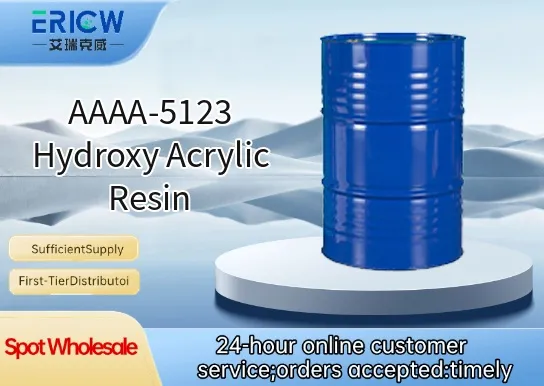
| Chemical Type | Hydroxy-functional acrylic copolymer |
| Product Form | Liquid resin solution |
| Appearance | Clear, pale yellow to water-white liquid |
| Solids Content (wt%) | 75.0 ± 1.0% |
| Hydroxyl Value (mg KOH/g) | 85–95 |
| Acid Value (mg KOH/g) | < 5.0 |
| Viscosity (25°C, mPa·s) | 2,500–4,000 (Brookfield RV-DV2T, spindle #3, 20 rpm) |
| Primary Applications | Thermoset industrial and automotive coatings |
Q1: What is the primary functional role of AAAA-5123 in coating formulations?
A: AAAA-5123 serves as a hydroxyl-functional acrylic resin that provides reactive sites for crosslinking with melamine, polyisocyanate, or other multifunctional curing agents—enhancing film hardness, chemical resistance, and thermal stability in thermoset coatings.
Q2: Is AAAA-5123 compatible with common solvent-based and high-solids coating systems?
A: Yes, AAAA-5123 exhibits good compatibility with aromatic and aliphatic hydrocarbon solvents, esters, and ketones, and is widely used in both conventional solvent-borne and high-solids architectural, industrial, and automotive refinish coatings.
Q3: How does AAAA-5123 contribute to weatherability and UV resistance in exterior coatings?
A: As a non-yellowing acrylic backbone resin with controlled molecular architecture, AAAA-5123 supports excellent gloss retention, chalking resistance, and long-term color stability under UV exposure—especially when formulated with appropriate UV absorbers and HALS stabilizers.
Q4: Can AAAA-5123 be used in low-VOC or water-reducible systems?
A: While inherently solvent-soluble, AAAA-5123 can be incorporated into water-reducible systems via emulsification or hybrid dispersion techniques—often requiring co-solvents and careful pH and surfactant selection to maintain colloidal stability.
Contact With Us:
E-mail: wangxingqiang@ericwchem.com
Have a Questions? Call Us:
Add:
Building A1, Jiete Industrial Park, Huangpu District, Guangzhou City, Guangdong Province, China