English
 Español
 tiếng việt
 русский
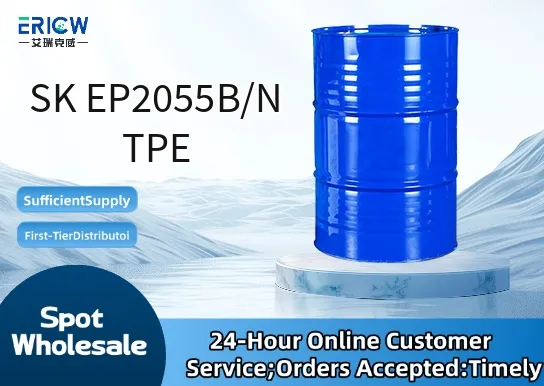
Excellent soft-touch feel with balanced hardness (Shore A 55) for ergonomic design integration.
Good processability via injection molding and extrusion, enabling high-cycle production efficiency.
Enhanced thermal stability up to 130°C short-term, supporting reliable performance in warm environments.
Low extractables and compliance with FDA 21 CFR §177.2600 for food-contact-adjacent applications.
Superior adhesion to polypropylene (PP) and polyethylene (PE), facilitating multi-material overmolding.
Soft-grip handles for power tools and hand-held appliances.
Sealing rings and gaskets in automotive fluid systems.
Consumer electronics casings and protective sleeves.
Medical device components requiring tactile feedback and biocompatibility support.
Household appliance control knobs and interface overlays.
| Chemical Type | Thermoplastic Elastomer (TPE) — Styrenic Block Copolymer (SBC) based |
| Product Form | Pellets |
| Appearance | Light beige, free-flowing granules |
| Shore A Hardness | 55 ± 3 |
| Melt Flow Rate (200°C/5 kg) | 18–22 g/10 min |
| Density | 0.91 g/cm³ |
| Key Features | Soft-touch surface, PP/PE adhesion, low volatility, RoHS compliant |
| Primary Applications | Ergonomic overmolding, sealing components, consumer product interfaces |
Q1: What is the primary function of SK EP2055B/N TPE in thermoplastic elastomer formulations?
A: SK EP2055B/N TPE is a specialty processing aid and compatibilizer designed to enhance melt flow, improve dispersion of fillers or additives, and support phase adhesion in multi-component TPE systems—particularly in SEBS- or TPO-based compounds.
Q2: Is SK EP2055B/N TPE suitable for food-contact or medical-grade TPE applications?
A: While SK EP2055B/N TPE is formulated for high-purity performance and low volatility, it is not pre-certified for food-contact or medical use. End-use compliance requires full formulation-level testing and regulatory evaluation by the compounder or end manufacturer.
Q3: How should SK EP2055B/N TPE be incorporated into a TPE compound?
A: It is typically added during the compounding stage—either pre-blended with base polymer or fed directly into the extruder. Good dispersion is achieved under standard melt-processing conditions; no special drying or pre-treatment is required.
Q4: Does SK EP2055B/N TPE affect the mechanical properties of finished TPE parts?
A: When used within recommended dosage ranges, it generally maintains or slightly improves tensile strength and elongation at break while reducing melt viscosity. Over-addition may lead to softening or reduced hardness, so optimization is advised per application.
Q5: Can SK EP2055B/N TPE be used in combination with other functional additives like antioxidants or UV stabilizers?
A: Yes—it exhibits good compatibility with common TPE additives including hindered phenols, phosphites, and benzotriazole-type UV absorbers. However, synergistic or antagonistic interactions should be verified through application-specific stability testing.
Contact With Us:
E-mail: wangxingqiang@ericwchem.com
Have a Questions? Call Us:
Add:
Building A1, Jiete Industrial Park, Huangpu District, Guangzhou City, Guangdong Province, China