English
 Español
 tiếng việt
 русский
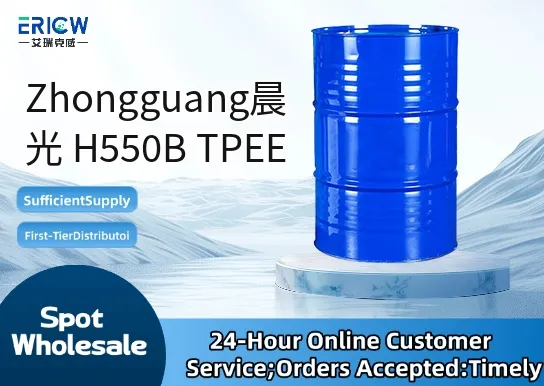
Excellent balance of thermoplastic processability and elastomeric performance.
High tensile strength and superior resilience at elevated temperatures.
Good resistance to oils, greases, and common industrial chemicals.
Outstanding low-temperature flexibility down to –40 °C.
Easy to process via injection molding, extrusion, and blow molding without pre-drying.
Automotive fluid handling components (e.g., brake hose covers, air ducts).
Industrial drive belts and timing belt teeth for high-efficiency power transmission.
Consumer electronics casings requiring impact resistance and soft-touch feel.
High-performance sporting goods parts such as ski bindings and bicycle suspension components.
Medical tubing and connectors demanding biocompatibility and kink resistance.
| Chemical Type | Thermoplastic Polyester Elastomer (TPEE) |
| Product Form | Pellets |
| Appearance | Off-white to light yellow, free-flowing granules |
| Primary Applications | Dynamic mechanical parts, flexible housings, fluid-contact components |
| Key Features | High modulus, fatigue resistance, dimensional stability |
| Benefits | Reduced part weight vs. thermoset rubber; recyclable processing scrap |
| Processing Method | Injection molding, extrusion, blow molding |
| Standard Packaging | 25 kg multi-layer moisture-proof bags |
Q1: What are the key processing advantages of Zhongguang H550B TPEE compared to conventional TPEEs?
A: Zhongguang H550B TPEE offers improved melt flow stability and reduced viscosity sensitivity during extrusion and injection molding, enabling smoother processing at moderate temperatures. Its balanced hard-segment content supports consistent part dimensional control and lower post-molding shrinkage in demanding thin-wall applications.
Q2: Is H550B suitable for dynamic sealing applications requiring repeated flexing and compression recovery?
A: Yes — H550B TPEE exhibits excellent resilience and low permanent set under cyclic compression, making it well-suited for gaskets, diaphragms, and other dynamic seals where long-term elastic performance is critical. Its phase-separated morphology contributes to reliable fatigue resistance across a broad service temperature range.
Q3: Can H550B be blended with other thermoplastics such as polyesters or polyolefins?
A: H550B demonstrates good compatibility with aromatic polyesters (e.g., PET, PBT) and can be used in alloy formulations to enhance toughness and low-temperature flexibility. Compatibility with non-polar polymers like PP or PE is limited without compatibilizers, and preliminary testing is recommended for any blend system.
Q4: How does moisture affect the processing of H550B TPEE, and what drying recommendations apply?
A: As a thermoplastic polyester elastomer, H550B is hygroscopic and requires thorough drying prior to processing. A standard recommendation is 4–6 hours at 100–110 °C with dew point ≤ −40 °C, though actual conditions should be adjusted based on ambient humidity and material history.
Contact With Us:
E-mail: wangxingqiang@ericwchem.com
Have a Questions? Call Us:
Add:
Building A1, Jiete Industrial Park, Huangpu District, Guangzhou City, Guangdong Province, China