English
 Español
 tiếng việt
 русский
Excellent melt flow and processability for high-speed extrusion and injection molding
Superior low-temperature flexibility and impact resistance down to –40 °C
Outstanding UV and thermal stability for long-term outdoor performance
Good compatibility with polypropylene (PP) and polyethylene (PE) for alloy formulations
Low extractables and compliance with FDA 21 CFR §177.1520 for food-contact applications
Automotive interior trim and soft-touch overmolding
Flexible packaging films requiring seal integrity and toughness
Medical tubing and disposable device components
Weather-resistant roofing membranes and geomembranes
High-performance thermoplastic elastomer (TPE) compounds for consumer goods
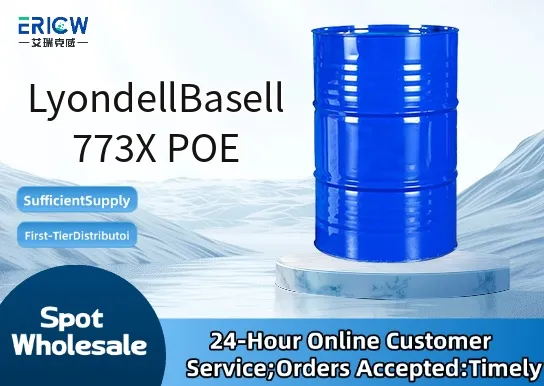
| Chemical Type | Polyolefin Elastomer (POE), ethylene-octene copolymer |
| Product Form | Pellets |
| Appearance | Off-white to light beige, free-flowing granules |
| Primary Applications | TPE compounding, PP/PE modification, flexible film, impact modification |
| Key Features | High elasticity, excellent clarity, low density (~0.87 g/cm³) |
| Benefits | Improved toughness without sacrificing stiffness; recyclable in polyolefin streams |
| Processing Method | Extrusion, injection molding, blow molding |
| Regulatory Compliance | REACH compliant; meets UL 94 HB flammability rating |
Q1: What is the primary function of LyondellBasell 773X POE in polymer formulations?
A: LyondellBasell 773X POE is an ethylene-octene copolymer elastomer designed primarily as a toughening agent and impact modifier—especially for rigid polyolefins such as PP and HDPE—enhancing ductility, low-temperature impact resistance, and melt processability without significantly compromising stiffness or thermal stability.
Q2: Is 773X POE compatible with polypropylene homopolymers and copolymers?
A: Yes, 773X POE exhibits excellent compatibility with both polypropylene homopolymers and random copolymers due to its polyolefinic backbone and balanced crystallinity. It is commonly used in PP-based automotive interior parts, packaging, and durable goods where improved notch sensitivity and weld-line strength are required.
Q3: How does 773X POE differ from conventional EPDM or EPR impact modifiers?
A: Unlike EPDM or EPR, which contain ethylene-propylene-diene monomers and may introduce crosslinking concerns or volatility issues during processing, 773X POE is a fully saturated, thermoplastic elastomer with no cure sites. This enables cleaner melt processing, better dispersion, recyclability, and consistent rheological behavior in extrusion and injection molding.
Q4: Can 773X POE be used in food-contact applications?
A: LyondellBasell 773X POE is manufactured using polymerization processes compliant with global food-contact regulations for polyolefins, and it is widely specified in food packaging films and containers. Final regulatory compliance depends on full formulation, processing conditions, and end-use requirements—users should consult applicable local regulations and conduct appropriate testing.
Contact With Us:
E-mail: wangxingqiang@ericwchem.com
Have a Questions? Call Us:
Add:
Building A1, Jiete Industrial Park, Huangpu District, Guangzhou City, Guangdong Province, China