English
 Español
 tiếng việt
 русский
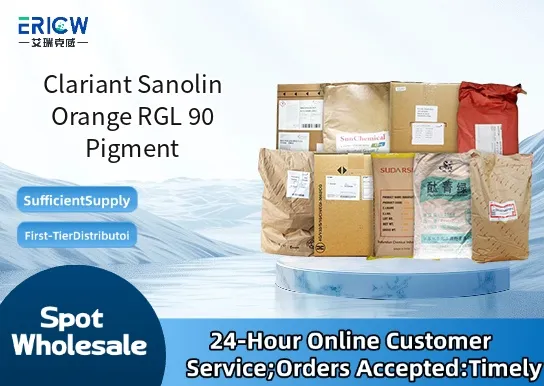
High chroma orange shade with excellent lightfastness and weather resistance.
Optimized for solvent-based and high-solids coating systems.
Good dispersibility in acrylic and polyester resin matrices.
Low volatile organic compound (VOC) contribution, supporting sustainable formulation goals.
Consistent batch-to-batch color performance and particle size distribution.
Automotive OEM and refinish coatings.
Industrial maintenance and protective coatings.
Plastic coloration for exterior automotive components.
General-purpose decorative architectural coatings.
Printing inks for packaging requiring durable outdoor exposure.
| Chemical Type | Azo pigment (disazo) |
| Product Form | Free-flowing powder |
| Appearance | Orange-red free-flowing powder |
| Primary Applications | Coatings, plastics, inks |
| Key Features | Good heat stability up to 180 °C, excellent migration resistance |
| Benefits | Enhanced color strength and gloss retention in demanding applications |
| Regulatory Compliance | REACH registered; compliant with EU Directive 2002/72/EC for food-contact plastics (subject to specific conditions) |
| Storage Conditions | Store in a cool, dry place away from direct sunlight and moisture |
Q1: What is the primary chemical class of Sanolin Orange RGL 90?
A: Sanolin Orange RGL 90 is an organic pigment based on a monoazo chromophore system, engineered for balanced color strength, lightfastness, and thermal stability in demanding polymer processing conditions.
Q2: Is this pigment suitable for food-contact plastics?
A: Sanolin Orange RGL 90 is designed for use in non-food-contact applications. For food-contact compliance, customers must consult Clariant’s regulatory documentation and verify suitability against applicable regional requirements—this grade is not pre-qualified for direct food-contact use.
Q3: How does it perform during high-shear extrusion or injection molding?
A: The pigment exhibits good dispersion stability and thermal resistance up to typical polyolefin and engineering plastic processing temperatures. It maintains color consistency with minimal degradation or gas evolution under standard high-shear compounding conditions.
Q4: What are recommended carrier resins or masterbatch systems?
A: Sanolin Orange RGL 90 is commonly formulated into polyolefin-based masterbatches (e.g., PP or LDPE carriers) and shows good compatibility with PVC, PS, and ABS. Selection of carrier should align with final application processing and performance targets.
Q5: What is the typical dosage range in end-use polymers?
A: Dosage depends on formulation requirements and desired shade intensity, but it is typically used at low concentrations—generally ranging from 0.1% to 2% by weight in final polymer products.
Contact With Us:
E-mail: wangxingqiang@ericwchem.com
Have a Questions? Call Us:
Add:
Building A1, Jiete Industrial Park, Huangpu District, Guangzhou City, Guangdong Province, China