English
 Español
 tiếng việt
 русский
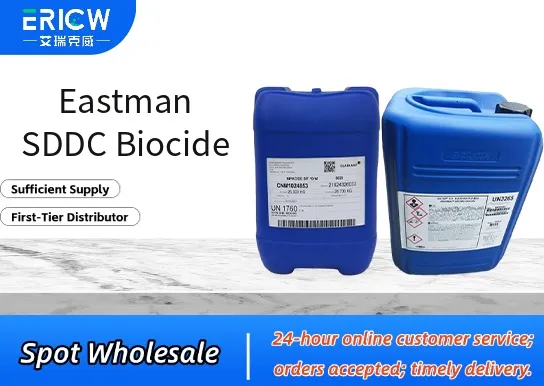
Broad-spectrum efficacy against bacteria, fungi, and algae in aqueous systems.
Stable across a wide pH range (pH 4–10), maintaining performance in diverse process conditions.
Low volatility and minimal odor, enhancing workplace safety and handling convenience.
Compatible with common water treatment additives, including corrosion inhibitors and dispersants.
Non-oxidizing chemistry, eliminating concerns related to oxidant demand or material degradation.
Cooling water systems in industrial HVAC and power generation facilities.
Process water circuits in paper manufacturing and pulp mills.
Recirculating water in metalworking fluid sumps and machining operations.
Preservation of emulsions, coatings, and adhesives during storage and formulation.
| Chemical Type | Organic biocide based on 1,2-benzisothiazolin-3-one (BIT) derivative |
| Product Form | Liquid concentrate |
| Appearance | Clear, pale yellow to amber liquid |
| Primary Applications | Industrial water treatment, preservation of water-based formulations |
| Key Features | Non-oxidizing, broad-spectrum, pH-stable, low-foaming |
| Benefits | Extended system uptime, reduced microbial fouling, compatibility with common additives |
| Storage Temperature | 5–30 °C (41–86 °F); protect from freezing and excessive heat |
| Shelf Life | 24 months unopened under recommended storage conditions |
Q1: What is the primary mode of action of Eastman SDDC Biocide?
A: Eastman SDDC Biocide functions as a broad-spectrum antimicrobial agent that disrupts microbial cell membranes and interferes with essential metabolic processes, leading to rapid inhibition of bacteria, fungi, and algae.
Q2: In which types of industrial formulations is Eastman SDDC Biocide commonly used?
A: It is widely incorporated into water-based industrial coatings, adhesives, sealants, construction chemicals, and polymer dispersions where long-term preservation against microbial spoilage is required during storage and in-service performance.
Q3: Is Eastman SDDC Biocide compatible with common thickeners and surfactants used in aqueous systems?
A: Yes, Eastman SDDC Biocide demonstrates good compatibility with a wide range of nonionic and anionic surfactants, as well as associative and non-associative thickeners typically found in architectural and industrial coatings formulations.
Q4: How should Eastman SDDC Biocide be added to a formulation for optimal efficacy?
A: It is recommended to add Eastman SDDC Biocide during the cool-down phase—typically after high-shear mixing and at temperatures below 50 °C—to minimize potential degradation and ensure uniform distribution throughout the final product.
Q5: Does Eastman SDDC Biocide offer residual protection in dried film applications?
A: While primarily designed to protect the liquid formulation from microbial growth during storage, Eastman SDDC Biocide may contribute limited dry-film protection depending on the matrix and exposure conditions—but it is not classified or marketed as a dedicated dry-film preservative.
Contact With Us:
E-mail: wangxingqiang@ericwchem.com
Have a Questions? Call Us:
Add:
Building A1, Jiete Industrial Park, Huangpu District, Guangzhou City, Guangdong Province, China