English
 Español
 tiếng việt
 русский
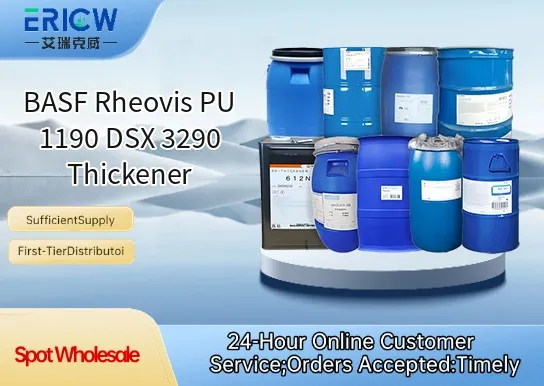
Non-ionic polyurethane rheology modifier delivering excellent viscosity build and sag resistance in waterborne systems.
Provides outstanding shear-thinning behavior for optimal application performance and leveling.
Compatible with a broad range of acrylic, vinyl acetate, and styrene-acrylic dispersions.
Enables low foam generation and good storage stability without compromising film formation.
Designed for easy incorporation via post-addition at ambient temperature without pre-dilution.
Interior architectural wall paints and primers.
Exterior façade coatings requiring high rain erosion resistance.
Waterborne industrial maintenance coatings.
Low-VOC decorative and protective coatings for wood and metal substrates.
Textured coatings and heavy-body finishes.
| Chemical Type | Non-ionic polyurethane associative thickener |
| Product Form | White to off-white viscous liquid |
| Appearance | Opaque, homogeneous dispersion |
| Primary Applications | Waterborne architectural and industrial coatings |
| Key Features | Sag resistance, shear-thinning, low foaming, compatibility with common binders |
| Benefits | Improved application properties, enhanced storage stability, simplified formulation |
| pH Range (as supplied) | 6.5 – 8.5 |
| Recommended Use Level | 0.2 – 1.0 wt% (based on total formulation) |
Q1: What type of rheology modifier is Rheovis PU 1190 DSX 3290?
A: Rheovis PU 1190 DSX 3290 is a hydrophobically modified polyurethane (HEUR) associative thickener designed to provide efficient viscosity build and excellent shear-thinning behavior in waterborne systems.
Q2: In which types of formulations is this thickener typically used?
A: It is commonly employed in architectural coatings, industrial maintenance paints, and water-based adhesives where balanced flow, sag resistance, and brush/roller application performance are required.
Q3: How does Rheovis PU 1190 DSX 3290 interact with other formulation components?
A: As an associative thickener, it functions via hydrophobic interactions with surfactants, latex particles, and other hydrophobic domains—making compatibility with surfactants and binder chemistry critical for optimal performance.
Q4: Is pre-dilution required before adding Rheovis PU 1190 DSX 3290 to the formulation?
A: Yes—pre-dilution in water or a compatible co-solvent is recommended to ensure uniform dispersion and avoid localized over-thickening or gel formation during incorporation.
Q5: What is the typical dosage range for effective thickening?
A: Dosage depends on formulation requirements but generally ranges from 0.1% to 2% by weight of the total formulation, with most applications achieving target viscosity at low to moderate concentrations.
Contact With Us:
E-mail: wangxingqiang@ericwchem.com
Have a Questions? Call Us:
Add:
Building A1, Jiete Industrial Park, Huangpu District, Guangzhou City, Guangdong Province, China