English
 Español
 tiếng việt
 русский
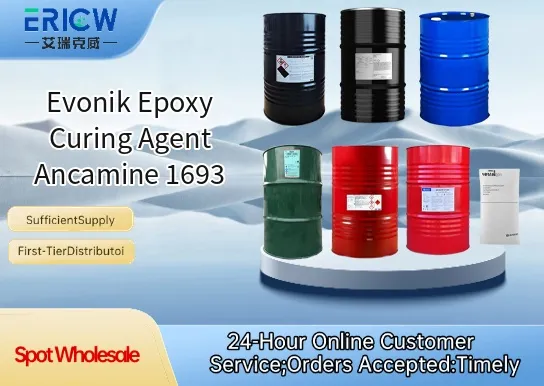
Low-viscosity, liquid aliphatic amine curing agent enabling excellent processability and easy metering.
Provides rapid room-temperature cure with good mechanical properties and chemical resistance.
Offers low exotherm during polymerization—ideal for thick-section casting and heat-sensitive substrates.
Compatible with standard bisphenol-A and bisphenol-F epoxy resins without need for solvents or modifiers.
Meets stringent VOC regulations with negligible volatile organic compound content.
Electrical encapsulation and potting compounds for transformers, sensors, and power electronics.
High-performance industrial flooring and heavy-duty protective coatings.
Adhesives and structural bonding systems in transportation and wind energy components.
Composite matrix resins for pultrusion and filament winding of fiberglass and carbon fiber parts.
Repair mortars and grouts requiring fast turnaround and high early strength development.
| Chemical Type | Aliphatic polyamine |
| Product Form | Liquid |
| Appearance | Clear, pale yellow to amber liquid |
| Primary Applications | Room-temperature and elevated-temperature epoxy curing |
| Key Features | Low viscosity, fast cure, low exotherm, solvent-free |
| Benefits | Improved work life control, reduced shrinkage, enhanced adhesion to metals and composites |
| Density (20 °C) | ~0.92–0.94 g/cm³ |
| Amine Value | ~380–420 mg KOH/g |
Q1: What is the primary chemical class of Ancamine 1693?
A: Ancamine 1693 is a modified aliphatic amine curing agent, designed to provide enhanced reactivity and improved compatibility with standard epoxy resins while maintaining favorable handling properties.
Q2: Is Ancamine 1693 suitable for ambient-cure applications?
A: Yes — it is formulated for efficient ambient-temperature curing of epoxy systems, delivering good early hardness development and acceptable pot life in typical industrial formulations.
Q3: How does Ancamine 1693 compare to traditional DETA or TETA in terms of odor and skin sensitization potential?
A: As a modified amine, Ancamine 1693 exhibits significantly reduced volatility and amine odor compared to conventional low-molecular-weight aliphatic amines, and its structural modification generally results in lower dermal sensitization risk — though appropriate occupational hygiene practices remain essential.
Q4: Can Ancamine 1693 be used in coatings requiring FDA-compliant food-contact performance?
A: Ancamine 1693 is not pre-approved for direct food-contact applications under FDA regulations; its use in such systems requires full formulation-level compliance evaluation, including extraction testing and regulatory review by qualified experts.
Contact With Us:
E-mail: wangxingqiang@ericwchem.com
Have a Questions? Call Us:
Add:
Building A1, Jiete Industrial Park, Huangpu District, Guangzhou City, Guangdong Province, China