English
 Español
 tiếng việt
 русский
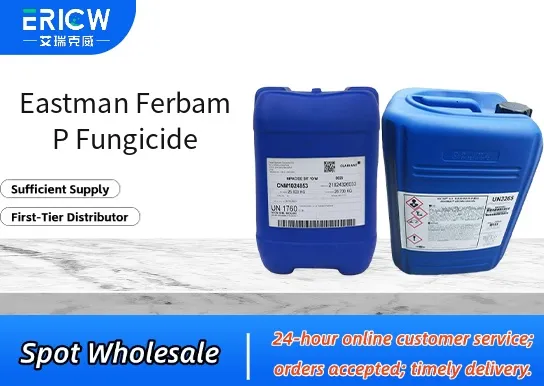
Broad-spectrum protective fungicidal activity against key foliar and soil-borne pathogens.
Contains ferbam (iron dimethyldithiocarbamate) as the active ingredient, offering reliable contact action.
Low volatility and favorable environmental profile with minimal risk of phytotoxicity under recommended use conditions.
Compatible with many conventional agrochemicals, supporting integration into standard tank-mix programs.
Stable formulation suitable for both ground and aerial application methods across diverse climatic conditions.
Vineyards for control of downy mildew (Plasmopara viticola) and black rot (Guignardia bidwellii).
Fruit orchards targeting scab (Venturia spp.) and leaf spot diseases in apples and pears.
Vegetable production systems including tomatoes, potatoes, and cucurbits for early blight and anthracnose management.
Nursery and greenhouse operations for preventive protection of ornamental and bedding plants.
| Chemical Type | Ferbam (iron dimethyldithiocarbamate) |
| Product Form | Wettable powder (WP) |
| Appearance | Gray to brown free-flowing powder |
| Active Ingredient Content | 70% w/w ferbam |
| Primary Applications | Agricultural fungicide for fruit, vegetable, and ornamental crops |
| Key Features | Contact mode of action, no systemic translocation |
| Storage Stability | Stable for 24 months when stored in original unopened container at 5–30°C |
| Compatibility | Generally compatible with most organophosphates, carbamates, and non-ionic adjuvants (compatibility testing recommended) |
Q1: What is the primary mode of action of Eastman Ferbam P Fungicide?
A: Eastman Ferbam P Fungicide functions as a multi-site contact fungicide, inhibiting key enzymatic processes in fungal cells through its dithiocarbamate chemistry. It provides broad-spectrum protection against a wide range of foliar and soil-borne pathogens by disrupting cellular respiration and protein synthesis.
Q2: In which types of formulations is Eastman Ferbam P commonly incorporated?
A: Eastman Ferbam P is widely used in aqueous suspension concentrates (SC), wettable powders (WP), and dustable powders (DP) for agricultural applications. Its physical stability and compatibility with common adjuvants and co-formulants make it suitable for tank-mixing with many insecticides and other fungicides.
Q3: Is Eastman Ferbam P suitable for use on edible crops?
A: Yes — Eastman Ferbam P is approved for use on a variety of fruits, vegetables, and field crops globally, subject to local regulatory authorization. Residue management and pre-harvest intervals must be followed per national or regional crop protection guidelines.
Q4: How does Eastman Ferbam P perform under varying environmental conditions?
A: Eastman Ferbam P exhibits good rainfastness once dried on plant surfaces and maintains efficacy across a broad temperature range. Its performance may be reduced under prolonged high humidity or heavy dew, where rapid fungal development can outpace protective coverage — thus timely application and proper spray coverage are critical.
Q5: What safety considerations apply during handling and formulation?
A: As with all dithiocarbamate fungicides, appropriate personal protective equipment (PPE) — including gloves, goggles, and respiratory protection when handling concentrated forms — is recommended. Formulators should consult the Safety Data Sheet (SDS) for detailed handling, storage, and disposal guidance, and ensure compliance with occupational exposure limits where established.
Contact With Us:
E-mail: wangxingqiang@ericwchem.com
Have a Questions? Call Us:
Add:
Building A1, Jiete Industrial Park, Huangpu District, Guangzhou City, Guangdong Province, China