English
 Español
 tiếng việt
 русский
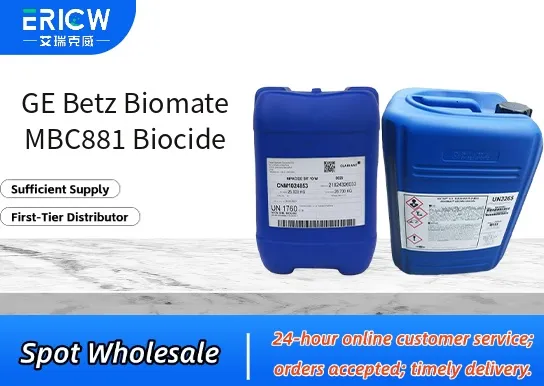
Broad-spectrum biocidal activity against bacteria, fungi, and algae in industrial water systems.
Non-oxidizing formulation compatible with common corrosion and scale inhibitors.
Effective at low dosage rates (50–200 ppm active), minimizing operational cost and handling risk.
Stable across a wide pH range (6.0–9.5) and tolerant to varying temperature and hardness conditions.
Low foam profile ensures reliable performance in high-turbulence recirculating cooling systems.
Industrial recirculating cooling water systems in power generation facilities.
Process water circuits in petrochemical and refinery operations.
Heat exchanger and condenser water loops requiring biofilm control.
Once-through and closed-loop systems where oxidizing biocides are incompatible.
Make-up water treatment for HVAC chillers and manufacturing cooling towers.
| Chemical Type | Heterocyclic nitrogen-containing compound (isothiazolinone derivative) |
| Product Form | Aqueous solution |
| Appearance | Clear, light amber liquid |
| pH (as supplied) | 3.0–5.0 |
| Density (20°C) | 1.08–1.12 g/cm³ |
| Solubility | Completely miscible with water |
| Primary Applications | Cooling water, process water, and heat exchange systems |
| Key Features | Non-oxidizing, low-foaming, broad-spectrum, inhibitor-compatible |
Q1: What is the primary mode of action for Biomate MBC881?
A: Biomate MBC881 is a broad-spectrum biocide formulated to control bacteria, fungi, and algae through membrane disruption and interference with essential cellular metabolism. Its active components act synergistically to deliver rapid and persistent microbiological control in industrial water systems.
Q2: In which types of industrial systems is MBC881 typically applied?
A: MBC881 is commonly used in recirculating cooling water systems, closed-loop chilled water systems, and process water applications where microbial growth poses risks to system integrity, heat transfer efficiency, or product quality. It is especially suited for systems requiring non-oxidizing, residual biocidal activity.
Q3: How does MBC881 perform under varying pH and temperature conditions?
A: MBC881 demonstrates stable performance across a wide operational pH range (typically pH 6–9) and maintains efficacy at elevated temperatures common in industrial cooling systems. Its formulation is designed to resist hydrolysis and degradation under typical system operating conditions.
Q4: Is MBC881 compatible with common corrosion and scale inhibitors?
A: Yes, MBC881 is generally compatible with major classes of water treatment additives—including phosphonates, polymers, azoles, and zinc-based corrosion inhibitors—when used within recommended dosage ranges and proper feed practices. Compatibility testing under site-specific conditions is always advised prior to full-scale implementation.
Q5: What safety and handling considerations apply to MBC881?
A: As with all industrial biocides, appropriate personal protective equipment (PPE) such as gloves, goggles, and respiratory protection should be used during handling. The product should be stored in a cool, dry, well-ventilated area away from incompatible materials. Safety Data Sheets (SDS) must be consulted before use to ensure compliance with local health, safety, and environmental requirements.
Contact With Us:
E-mail: wangxingqiang@ericwchem.com
Have a Questions? Call Us:
Add:
Building A1, Jiete Industrial Park, Huangpu District, Guangzhou City, Guangdong Province, China