English
 Español
 tiếng việt
 русский
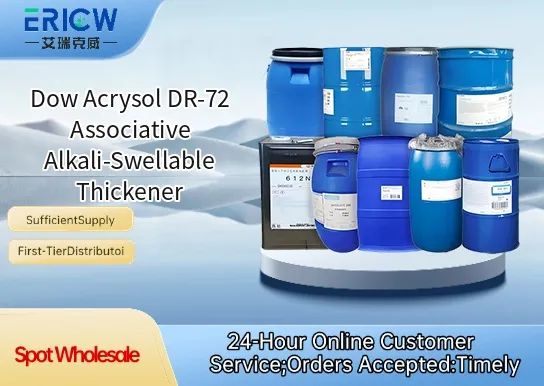
Delivers high-shear viscosity and excellent sag resistance in waterborne architectural coatings.
Provides outstanding rheology control and improved leveling without compromising spatter resistance.
Offers robust associative thickening via hydrophobic interactions, enhancing film formation and scrub resistance.
Enables low-odor, low-VOC formulations compatible with modern regulatory requirements.
Delivers consistent performance across a broad pH range (7.5–10.5) after alkaline activation.
Interior and exterior flat and low-sheen architectural paints.
Textured coatings and elastomeric wall finishes.
Primer formulations requiring balanced flow and anti-drip properties.
Waterborne industrial maintenance coatings.
Stain-blocking and high-hiding premium wall paints.
| Chemical Type | Associative alkali-swellable emulsion (ASE) |
| Product Form | Aqueous dispersion |
| Appearance | Opaque white liquid |
| pH (as received) | 2.5–4.0 |
| Active Content (wt%) | 28–32% |
| Viscosity (Brookfield RVT, Spindle #3, 20 rpm, 25°C) | 500–1,500 cP |
| Recommended Use Level (in final formulation) | 0.2–1.0% (w/w, based on total formulation) |
| Primary Applications | Architectural waterborne coatings |
Q1: How does DR-72 differ from conventional non-associative alkali-swellable thickeners (ASE)?
A: DR-72 is an associative alkali-swellable thickener (A-ASE), meaning it contains hydrophobic groups that enable intermolecular association in addition to the typical acid–base swelling mechanism. This provides superior rheology control—especially enhanced mid-shear viscosity, better sag resistance, and improved leveling—compared to traditional non-associative ASE thickeners.
Q2: What pH range is required for optimal thickening performance?
A: DR-72 requires alkaline activation for full viscosity development, typically achieving effective thickening at pH ≥ 8.0. Performance increases progressively up to pH 9.5–10.5, beyond which further pH elevation may not yield significant gains and could impact formulation stability in sensitive systems.
Q3: Is DR-72 compatible with common surfactants and co-thickeners used in architectural coatings?
A: Yes, DR-72 demonstrates good compatibility with anionic and nonionic surfactants commonly found in waterborne paints, as well as with other rheology modifiers such as HEUR thickeners and fumed silica. However, strong cationic species or high levels of certain biocides may interfere with associative network formation and should be evaluated case by case.
Q4: How should DR-72 be incorporated into a formulation to ensure consistent performance?
A: For best results, DR-72 should be added post-emulsification—typically during the let-down stage—after pH adjustment to the target range. It is recommended to dilute the thickener with water or a compatible solvent prior to addition and to allow sufficient mixing time (e.g., 15–30 minutes) for full hydration and network development before final pH fine-tuning or addition of other sensitive components.
Q5: Can DR-72 be used in low-VOC or zero-VOC formulations?
A: Yes, DR-72 is suitable for low-VOC and zero-VOC architectural and industrial coatings, as it contains no added organic solvents or VOC-contributing components. Its performance remains effective in water-rich systems where co-solvent levels are minimized.
Contact With Us:
E-mail: wangxingqiang@ericwchem.com
Have a Questions? Call Us:
Add:
Building A1, Jiete Industrial Park, Huangpu District, Guangzhou City, Guangdong Province, China