English
 Español
 tiếng việt
 русский
Highly selective for low-temperature CO shift conversion in syngas purification.
Exceptional thermal and chemical stability under fluctuating process conditions.
Optimized sulfur tolerance enabling robust operation with typical feed impurities.
Low-pressure drop design suitable for fixed-bed reactor configurations.
Pre-sulfided formulation eliminates need for on-site activation, reducing commissioning time.
Hydrogen production via water-gas shift (WGS) in ammonia plants.
Syngas conditioning for Fischer–Tropsch synthesis units.
Clean hydrogen generation for refineries and hydroprocessing units.
Carbon monoxide abatement in fuel cell hydrogen supply systems.
Integrated gasification combined cycle (IGCC) power generation support.
| Chemical Type | Copper–zinc oxide–alumina (CuO/ZnO/Al₂O₃) based shift catalyst |
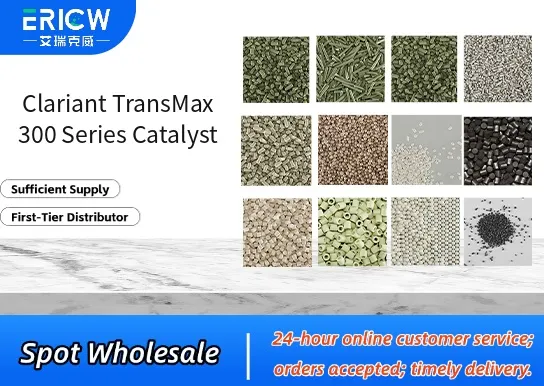
| Product Form | Extruded pellets (cylindrical, ~3–5 mm diameter) |
| Appearance | Gray to dark gray free-flowing granular solid |
| Primary Applications | Low-temperature water-gas shift reaction (200–260 °C) |
| Key Features | Pre-sulfided, high activity, sulfur-tolerant, stable under steam-rich conditions |
| Benefits | Reduced start-up time, extended catalyst life, lower operating temperature, improved H₂ yield |
| Storage Requirements | Store in sealed containers under dry, inert atmosphere; avoid moisture exposure |
| Handling Precautions | Use in well-ventilated areas; avoid inhalation of dust; refer to SDS for full safety guidance |
Q1: What is the primary function of the TransMax 300 Series in polymer processing?
A: The TransMax 300 Series is a highly efficient transesterification catalyst designed to accelerate ester exchange reactions—particularly in polycondensation and polymer modification processes—enabling improved molecular weight development, enhanced melt stability, and more consistent rheological behavior during extrusion or melt processing.
Q2: Is the TransMax 300 Series suitable for use in food-contact or medical-grade polymer applications?
A: While the TransMax 300 Series is formulated for high-purity performance and low volatility, its suitability for regulated applications depends on final formulation compliance, processing conditions, and end-use requirements. Customers must conduct full regulatory evaluation—including extractables and migration testing—as part of their qualification process.
Q3: How does the TransMax 300 Series compare to traditional tin-based catalysts in terms of thermal stability and residue formation?
A: Unlike conventional tin catalysts, the TransMax 300 Series offers superior thermal stability under typical melt-processing conditions and significantly reduces the risk of undesirable discoloration or metal-derived residues—making it especially valuable for light-colored or optically sensitive engineering thermoplastics.
Q4: What are the recommended handling and storage conditions for this catalyst?
A: TransMax 300 Series should be stored in its original sealed container at temperatures between 10–30 °C, protected from moisture and direct sunlight. It is hygroscopic and may undergo gradual hydrolysis upon prolonged exposure to ambient humidity—therefore, containers should be resealed promptly after use and handled under dry conditions.
Contact With Us:
E-mail: wangxingqiang@ericwchem.com
Have a Questions? Call Us:
Add:
Building A1, Jiete Industrial Park, Huangpu District, Guangzhou City, Guangdong Province, China