English
 Español
 tiếng việt
 русский
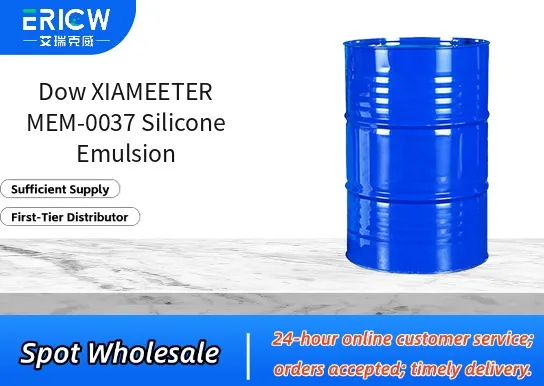
Highly stable anionic silicone emulsion with excellent shelf life under ambient storage conditions.
Provides superior lubricity and surface slip for improved processing in aqueous systems.
Offers good compatibility with common water-based polymers, surfactants, and thickeners.
Delivers consistent softening and anti-static effects on textile and nonwoven substrates.
Low foaming profile suitable for high-shear industrial coating and finishing operations.
Textile softening and handle modification for cotton, polyester, and blends.
Nonwoven fabric treatment to enhance drape, sewability, and static control.
Leather finishing agent for improved grain smoothness and flexibility.
Component in water-based coatings and inks for controlled surface migration and mar resistance.
Additive in paper and board coatings to improve sheet runnability and surface feel.
| Chemical Type | Dimethyl silicone polymer emulsion (anionic) |
| Product Form | Liquid emulsion |
| Appearance | Opaque white to off-white liquid |
| pH (1% aqueous solution) | 5.5 – 7.0 |
| Active Content (wt%) | 30 ± 1% |
| Viscosity (mPa·s, Brookfield DV-E, #3 spindle, 20 rpm) | 50 – 200 |
| Particle Size (D50, nm) | 150 – 300 |
| Freeze-Thaw Stability | Passes 3 cycles (–10°C for 16 h / 25°C for 8 h) |
Q1: What is the primary function of MEM-0037 in coating and ink formulations?
A: MEM-0037 is a non-ionic, anionic-stabilized silicone emulsion designed to provide surface leveling, substrate wetting, and foam control in water-based coatings, inks, and adhesives. It helps reduce surface defects such as craters, orange peel, and pinholes while enhancing gloss uniformity and substrate coverage.
Q2: Is MEM-0037 compatible with common water-based polymer systems?
A: Yes, MEM-0037 demonstrates broad compatibility with acrylics, vinyl acetate copolymers, styrene-acrylic dispersions, and polyurethane dispersions. It is formulated for stability in neutral to mildly alkaline pH ranges (typically pH 6–9) and generally remains stable in the presence of common thickeners and coalescing agents.
Q3: How should MEM-0037 be incorporated into a formulation?
A: MEM-0037 is typically added during the let-down stage, after high-shear dispersion of pigments and fillers. It should be diluted with water or formulation water prior to addition and mixed under moderate agitation to ensure uniform distribution. Avoid high-shear mixing post-addition to prevent potential emulsion destabilization.
Q4: Does MEM-0037 affect film formation or drying behavior?
A: MEM-0037 is designed to minimize interference with film formation. Its low-volatility silicone components remain at the air–film interface, supporting surface optimization without significantly retarding water evaporation or coalescence. Drying times remain largely unaffected when used at recommended dosage levels.
Contact With Us:
E-mail: wangxingqiang@ericwchem.com
Have a Questions? Call Us:
Add:
Building A1, Jiete Industrial Park, Huangpu District, Guangzhou City, Guangdong Province, China