English
 Español
 tiếng việt
 русский
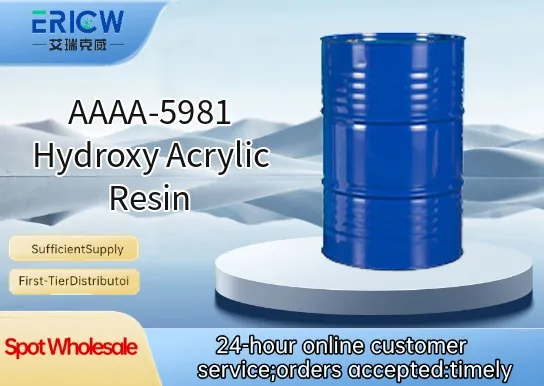
High hydroxyl functionality for excellent crosslinking efficiency with melamine and polyisocyanate curing agents.
Outstanding weather resistance and UV stability, suitable for long-term outdoor exposure.
Low VOC content compliant with major global regulatory standards (e.g., EPA Method 24, EU Directive 2004/42/EC).
Excellent compatibility with common acrylic, polyester, and cellulose ester resins in solvent-borne systems.
Good flow and leveling characteristics, enabling high-gloss, defect-free film formation.
Automotive OEM clearcoats and basecoats requiring high durability and gloss retention.
Industrial maintenance coatings for metal substrates in architectural and infrastructure sectors.
High-performance coil coatings for pre-painted steel and aluminum applications.
Refinish coatings in automotive and heavy-duty equipment repair markets.
| Chemical Type | Hydroxy-functional acrylic copolymer |
| Product Form | Liquid resin solution |
| Appearance | Clear, pale yellow to colorless liquid |
| Primary Applications | Crosslinkable topcoats, OEM and refinish coatings |
| Key Features | High OH value, low viscosity, good solubility in aromatic and ketonic solvents |
| Benefits | Enhanced cure speed, superior hardness development, and excellent chemical resistance |
| Solvent System | Xylene / butyl acetate / MEK blend (typical) |
| Storage Stability | ≥12 months at 25°C in sealed container |
Q1: What is the primary functional role of AAAA-5981 in coating formulations?
A: AAAA-5981 serves as a hydroxyl-functional acrylic resin designed to act as a reactive co-resin in thermosetting systems—particularly with amino crosslinkers (e.g., melamine or urea-formaldehyde resins) and isocyanate-based hardeners. Its pendant hydroxyl groups enable covalent network formation during cure, enhancing film hardness, chemical resistance, and thermal stability.
Q2: Is AAAA-5981 suitable for high-solids or low-VOC applications?
A: Yes—AAAA-5981 is formulated to deliver good solution viscosity at elevated solids content, supporting high-solids coating systems. It can be effectively used in solventborne formulations targeting VOC reduction, though final compliance depends on the full formulation matrix and regulatory jurisdiction.
Q3: How does AAAA-5981 compare to polyester-based hydroxyl resins in terms of weatherability and yellowing resistance?
A: As an acrylic backbone resin, AAAA-5981 offers inherently superior UV stability and resistance to yellowing compared to many conventional hydroxyl-functional polyesters. This makes it especially well-suited for exterior topcoats and applications where long-term gloss retention and color stability are critical.
Q4: What solvents are typically recommended for diluting AAAA-5981?
A: AAAA-5981 exhibits good compatibility with common industrial solvents including aromatic hydrocarbons (e.g., xylene), ketones (e.g., MEK, MIBK), and esters (e.g., butyl acetate). Solvent selection should consider evaporation rate, polarity, and compatibility with other formulation components.
Q5: Can AAAA-5981 be used in two-component polyurethane systems?
A: Yes—AAAA-5981 is commonly employed as the hydroxyl component in 2K PU systems. Its controlled molecular weight distribution and hydroxyl value facilitate predictable reactivity and film formation when paired with aliphatic or aromatic isocyanate crosslinkers.
Contact With Us:
E-mail: wangxingqiang@ericwchem.com
Have a Questions? Call Us:
Add:
Building A1, Jiete Industrial Park, Huangpu District, Guangzhou City, Guangdong Province, China