English
 Español
 tiếng việt
 русский
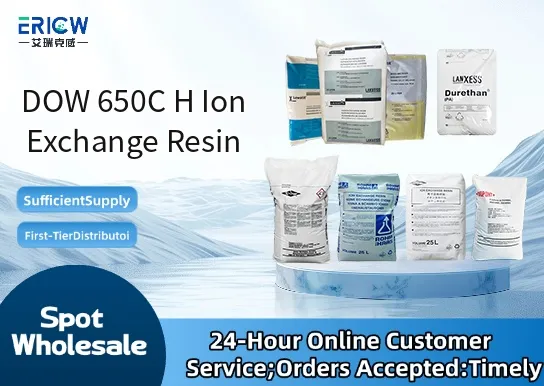
High-capacity, gel-type strong acid cation exchange resin in hydrogen form.
Optimized bead uniformity and high physical stability for consistent hydraulic performance.
Low soluble organics (TOC) release—ideal for ultrapure water production where organic contamination must be minimized.
Excellent regeneration efficiency with standard mineral acids, reducing operational chemical consumption.
Robust crosslinked polystyrene-divinylbenzene matrix ensuring long service life under repeated cycling.
Polishing deionization in semiconductor-grade ultrapure water (UPW) systems.
Pretreatment and final polishing in pharmaceutical water-for-injection (WFI) and purified water (PW) generation.
Condensate polishing in fossil fuel and nuclear power plant steam cycles.
High-purity industrial process water for electronics manufacturing and battery-grade lithium processing.
Removal of dissolved cations in laboratory and analytical water purification systems.
| Chemical Type | Strong acid cation (sulfonic acid), hydrogen form |
| Product Form | Moist, spherical beads |
| Appearance | Amber, transparent gel beads |
| Functional Group | Sulfonic acid (–SO₃H) |
| Matrix Structure | Crosslinked polystyrene-divinylbenzene (8% DVB) |
| Ion Exchange Capacity (min) | 1.9 eq/L (dry base) |
| Moisture Content | 45–50% (as shipped) |
| Uniformity Coefficient (max) | 1.7 |
Q1: What is the primary functional form of DOW 650C H resin upon delivery?
A: DOW 650C H is supplied in the hydrogen (H⁺) form, optimized for cation exchange applications such as demineralization, softening, and acid removal in water treatment systems.
Q2: Can DOW 650C H be used in high-purity water production for pharmaceutical or electronics applications?
A: Yes — it is commonly employed in polishing stages of high-purity water systems due to its high chemical stability, low extractables, and consistent kinetic performance when regenerated with strong acid.
Q3: How does DOW 650C H compare to gel-type resins in terms of fouling resistance?
A: As a macroporous resin, DOW 650C H offers improved resistance to organic fouling and better performance in waters containing oxidants or suspended solids compared to conventional gel-type cation exchangers.
Q4: What regeneration chemicals are recommended for DOW 650C H resin?
A: Sulfuric acid or hydrochloric acid are typically used for regeneration. The choice depends on system design, feedwater composition, and operational preferences — with HCl generally preferred where sulfate scaling is a concern.
Contact With Us:
E-mail: wangxingqiang@ericwchem.com
Have a Questions? Call Us:
Add:
Building A1, Jiete Industrial Park, Huangpu District, Guangzhou City, Guangdong Province, China