English
 Español
 tiếng việt
 русский
Highly stable macroporous acrylic matrix ensures exceptional chemical and mechanical durability under demanding regeneration cycles.
Optimized for selective removal of multivalent cations including calcium, magnesium, heavy metals, and transition metal ions.
Low osmotic swelling behavior provides consistent bed volume stability across pH and ionic strength variations.
Excellent kinetic performance with rapid mass transfer due to well-defined pore structure and high surface area.
Compatible with standard regenerants including HCl, H₂SO₄, and NaCl—enabling flexible process integration and cost-efficient operation.
Removal of hardness ions (Ca²⁺, Mg²⁺) in industrial boiler feedwater pretreatment systems.
Purification of process streams in pharmaceutical manufacturing where low metal leaching and USP-grade compliance are critical.
Treatment of electronic-grade ultrapure water (UPW) for semiconductor rinse applications.
Recovery and separation of valuable metal ions (e.g., Ni²⁺, Co²⁺, Cu²⁺) from electroplating effluents.
Decolorization and trace metal polishing in sugar refining and organic acid production.
| Chemical Type | Macroporous acrylic strong acid cation exchange resin |
| Product Form | Moist, spherical beads |
| Appearance | Opaque off-white to light yellow beads |
| Functional Group | Sulfonic acid (–SO₃H) |
| Ionic Form | H⁺ form (ready-to-use) |
| Particle Size Range | 0.3 – 1.2 mm |
| Moisture Content | 45 – 55 % (w/w) |
| Exchange Capacity (min.) | ≥ 2.0 eq/L (H⁺ form, dry basis) |
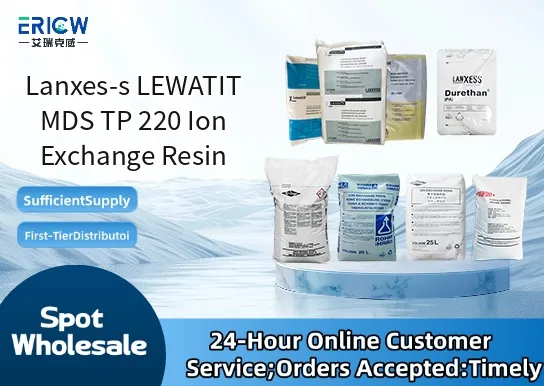
Q1: What is the primary functional group and base matrix of LEWATIT MDS TP 220?
A: LEWATIT MDS TP 220 is a macroporous, strongly acidic cation exchange resin based on a styrene-divinylbenzene copolymer matrix, functionalized with sulfonic acid groups. Its macroporous structure provides enhanced kinetic performance and stability in non-aqueous or low-polarity media.
Q2: In which types of industrial processes is this resin most commonly applied?
A: This resin is widely used for selective removal of multivalent metal ions (e.g., Ca²⁺, Mg²⁺, Fe³⁺, Cu²⁺) from organic solvents, polar aprotic media, and process streams containing alcohols, glycols, or esters. Typical applications include purification of specialty chemicals, catalyst recovery, and pretreatment of feedstocks prior to sensitive downstream reactions.
Q3: How does LEWATIT MDS TP 220 compare to gel-type cation resins in terms of chemical and thermal stability?
A: Due to its macroporous structure and highly crosslinked matrix, MDS TP 220 offers superior resistance to oxidation, osmotic shock, and elevated temperatures compared to conventional gel-type resins. It maintains mechanical integrity and exchange capacity under repeated regeneration cycles involving strong acids or varying solvent compositions.
Q4: What regeneration protocols are recommended for optimal long-term performance?
A: Regeneration is typically performed using aqueous mineral acids such as HCl or H₂SO₄ at moderate concentrations. The choice of regenerant, contact time, and flow rate should be optimized based on the nature and loading of adsorbed ions. Thorough rinsing with deionized water or compatible solvent is essential before reuse in sensitive applications.
Contact With Us:
E-mail: wangxingqiang@ericwchem.com
Have a Questions? Call Us:
Add:
Building A1, Jiete Industrial Park, Huangpu District, Guangzhou City, Guangdong Province, China