English
 Español
 tiếng việt
 русский
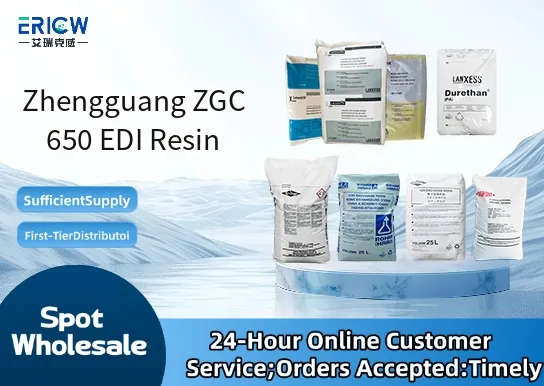
Highly uniform spherical bead morphology ensures stable hydraulic performance and low pressure drop in EDI modules.
Optimized ion exchange capacity balance between cation and anion resins for efficient continuous deionization.
Excellent chemical and osmotic stability under long-term operation in high-purity water systems.
Low organic extractables and minimal TOC leaching, meeting stringent requirements for pharmaceutical and microelectronics ultrapure water.
Pre-mixed and pre-conditioned in optimal volume ratio (1:1 ±0.05), ready for direct loading into standard EDI stacks.
Ultrapure water production for semiconductor wafer cleaning and photolithography processes.
Pharmaceutical-grade purified water (PW) and water for injection (WFI) polishing systems.
Power plant boiler feedwater treatment requiring >18.0 MΩ·cm resistivity.
Laboratory and analytical instrument feedwater systems demanding consistent low silica and sodium breakthrough.
Food & beverage high-purity process water polishing where microbial and ionic stability are critical.
| Chemical Type | Mixed-bed, pre-blended strong acid cation (SAC) and strong base anion (SBA) resins |
| Product Form | Moist, pre-conditioned spherical beads |
| Appearance | Uniform milky-white to light amber beads (cations) and pale yellow beads (anions), visibly well-mixed |
| Primary Applications | Continuous electrodeionization (EDI) for ultrapure water generation |
| Key Features | Low pressure drop, high current efficiency, minimal gas generation during operation |
| Benefits | Extended module service life, reduced maintenance frequency, consistent product water quality |
| Storage Conditions | 5–35 °C, protected from freezing and direct sunlight; keep container sealed |
| Regeneration Requirement | None — designed for continuous electrochemical regeneration in EDI systems |
Q1: What is the primary function of Zhengguang ZGC 650 EDI Resin in water purification systems?
A: Zhengguang ZGC 650 EDI Resin is a mixed-bed ion exchange resin specifically engineered for use in electrodeionization (EDI) modules. It enables continuous deionization of feedwater without chemical regeneration, producing high-purity water suitable for pharmaceutical, semiconductor, and power generation applications.
Q2: How does ZGC 650 differ from conventional mixed-bed resins used in batch-type deionizers?
A: Unlike standard mixed-bed resins designed for intermittent regeneration cycles, ZGC 650 features optimized particle size distribution, enhanced mechanical strength, and low regenerant carryover characteristics—making it suitable for long-term, electrically driven operation in EDI stacks where stable conductivity and minimal pressure drop are critical.
Q3: Is ZGC 650 compatible with common EDI system designs, including those from major OEMs?
A: Yes, ZGC 650 is formulated to meet dimensional and electrochemical performance requirements typical of industrial EDI modules. It has been validated for use in standard cell-stack configurations and is widely deployed as a direct replacement or upgrade option in systems originally specified for similar high-efficiency mixed-bed resins.
Q4: What are the key handling and storage recommendations for this resin?
A: ZGC 650 should be stored in its original sealed packaging at temperatures between 5 °C and 35 °C, away from direct sunlight and freezing conditions. Once opened, minimize exposure to ambient air and install promptly to avoid moisture loss or contamination. Pre-rinsing with deionized water is recommended before initial system commissioning.
Contact With Us:
E-mail: wangxingqiang@ericwchem.com
Have a Questions? Call Us:
Add:
Building A1, Jiete Industrial Park, Huangpu District, Guangzhou City, Guangdong Province, China