English
 Español
 tiếng việt
 русский
Excellent abrasion resistance for extended service life in demanding mechanical environments.
High tensile strength and elongation at break, enabling robust performance under dynamic stress.
Good low-temperature flexibility down to –30 °C, maintaining elasticity in cold-condition applications.
Outstanding oil and grease resistance, ensuring dimensional stability in contact with hydrocarbon-based fluids.
Processable via standard thermoplastic methods including extrusion, injection molding, and calendering.
Automotive interior trim components such as instrument panel skins and door armrests.
Industrial hoses and fluid transfer tubing requiring chemical resistance and kink recovery.
Wear-resistant footwear outsoles and midsoles for athletic and work footwear.
Medical device tubing and non-implantable components requiring biocompatibility (ISO 10993 tested).
Consumer electronics protective cases and flexible cable jacketing.
| Chemical Type | Thermoplastic Polyurethane (TPU), polyester-based |
| Product Form | Pellets |
| Appearance | Opaque, off-white to light tan granules |
| Primary Applications | Extruded profiles, molded parts, flexible films, and coated fabrics |
| Key Features | Abrasion resistance, oil resistance, low-temperature flexibility, melt processability |
| Benefits | Reduced part wear, enhanced durability, design freedom for complex geometries, recyclable thermoplastic processing |
| Processing Method | Extrusion, injection molding, blow molding, calendering |
| Compliance | RoHS compliant; meets FDA requirements for indirect food contact (21 CFR §177.1680) |
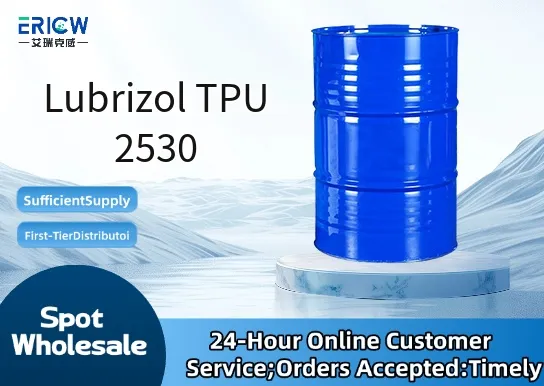
Q1: What is Lubrizol TPU 2530 primarily used for?
A: Lubrizol TPU 2530 is a thermoplastic polyurethane-based additive designed to enhance melt processability, improve surface finish, and reduce friction in thermoplastic elastomer (TPE) and engineering thermoplastic formulations—particularly in extrusion and injection molding applications.
Q2: Is Lubrizol TPU 2530 compatible with common thermoplastics like PP, PE, or TPEs?
A: Yes, TPU 2530 demonstrates broad compatibility with polyolefins (e.g., PP, HDPE), styrenic TPEs (e.g., TPS), and other thermoplastic elastomers. Compatibility should be verified experimentally in the final formulation due to variability in polymer architecture and processing conditions.
Q3: How is Lubrizol TPU 2530 typically incorporated into a compound?
A: It is commonly introduced during compounding via twin-screw extrusion, either as a masterbatch or direct feed. Pre-drying is generally not required, but handling under low-humidity conditions is recommended to maintain consistent feeding and dispersion.
Q4: Does Lubrizol TPU 2530 affect the mechanical properties of the base polymer?
A: At typical use levels, it maintains the core mechanical performance—such as tensile strength and elongation—while improving flow and surface aesthetics. Significant dosage increases may influence modulus or hardness, so optimization is advised for critical end-use requirements.
Q5: Can Lubrizol TPU 2530 support regulatory compliance for food-contact or medical applications?
A: TPU 2530 is formulated from components commonly used in regulated polymer systems, but final compliance depends on the complete formulation, processing history, and applicable jurisdictional requirements. Lubrizol provides supporting documentation upon request to assist with regulatory assessments.
Contact With Us:
E-mail: wangxingqiang@ericwchem.com
Have a Questions? Call Us:
Add:
Building A1, Jiete Industrial Park, Huangpu District, Guangzhou City, Guangdong Province, China