English
 Español
 tiếng việt
 русский
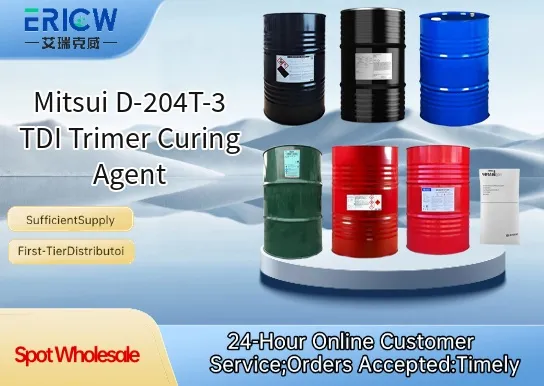
Highly stable aliphatic trimer structure ensures excellent storage stability and low volatility.
Low free TDI monomer content (< 0.1 wt%) meets stringent occupational health and environmental compliance requirements.
Consistent reactivity profile enables predictable gel times and robust crosslinking in polyurethane systems.
Excellent compatibility with polyester and polyether polyols, facilitating homogeneous formulation without phase separation.
Delivers superior chemical resistance and mechanical toughness in cured thermoset coatings and adhesives.
High-performance two-component polyurethane coatings for industrial metal protection.
Automotive refinish clearcoats requiring rapid cure, gloss retention, and mar resistance.
Flexible and rigid foam systems where controlled reactivity and low fogging are critical.
UV-resistant elastomeric sealants and construction joint fillers.
Polyurethane-based textile and leather finishing resins for durable soft-touch effects.
| Chemical Type | TDI-based isocyanurate trimer |
| Product Form | Liquid |
| Appearance | Clear, pale yellow to amber viscous liquid |
| NCO Content (wt%) | 15.5 – 16.5 |
| Viscosity at 25°C (mPa·s) | 1,800 – 2,500 |
| Free TDI (wt%) | ≤ 0.1 |
| Acid Number (mg KOH/g) | ≤ 0.5 |
| Storage Stability | Stable for ≥ 12 months at 15–25°C in sealed containers |
Q1: What is the primary chemical composition and functional role of Mitsui D-204T-3?
A: Mitsui D-204T-3 is a trifunctional isocyanurate-type curing agent derived from toluene diisocyanate (TDI), designed to provide enhanced crosslink density, thermal stability, and chemical resistance in polyurethane coatings and adhesives. Its trimer structure contributes to improved hardness and reduced volatility compared to monomeric isocyanates.
Q2: How does D-204T-3 differ from other TDI-based trimers or HDI-based curing agents?
A: Unlike aliphatic HDI trimers, D-204T-3 offers aromatic character, resulting in higher reactivity with hydroxyl groups and superior mechanical strength and solvent resistance in final films. Compared to other TDI trimers, it is formulated for consistent viscosity and storage stability, supporting easier handling and broader formulation flexibility in industrial coating systems.
Q3: What are typical processing considerations—such as pot life, mixing ratio, and cure conditions—when using D-204T-3?
A: D-204T-3 exhibits moderate reactivity, offering a practical pot life suitable for ambient- or elevated-temperature curing processes. It is typically used at low concentrations relative to the resin component, and dosage depends on formulation requirements—including desired film hardness, flexibility, and cure speed. Post-cure at elevated temperatures may enhance crosslink development and performance properties.
Q4: Is D-204T-3 compatible with common polyol resins and additives used in high-performance coatings?
A: Yes, D-204T-3 demonstrates broad compatibility with polyester, acrylic, and polyether polyols, as well as standard catalysts, flow agents, and UV stabilizers. Compatibility testing under actual formulation conditions is recommended to ensure optimal dispersion, stability, and final film performance.
Contact With Us:
E-mail: wangxingqiang@ericwchem.com
Have a Questions? Call Us:
Add:
Building A1, Jiete Industrial Park, Huangpu District, Guangzhou City, Guangdong Province, China