English
 Español
 tiếng việt
 русский
Excellent melt processability for extrusion, injection molding, and blow molding
Outstanding abrasion resistance and mechanical toughness at ambient and elevated temperatures
Good low-temperature flexibility with retained elasticity down to –30 °C
Hydrolysis-resistant aliphatic polyester-based thermoplastic polyurethane
Compatible with common engineering plastics for co-extrusion and overmolding applications
Automotive interior trim components including soft-touch overlays and instrument panel skins
Medical tubing and fluid handling systems requiring biocompatibility and kink resistance
Industrial hoses and pneumatic tubing for demanding dynamic flex environments
Consumer electronics protective casings and wearable device straps
High-performance sporting goods such as ski boot cuffs and bicycle grips
| Chemical Type | Aliphatic polyester-based thermoplastic polyurethane (TPU) |
| Product Form | Pellets |
| Appearance | Off-white to light tan, free-flowing granules |
| Primary Applications | Extruded profiles, injection-molded parts, blow-molded containers |
| Key Features | Melt-processable, hydrolysis-stable, excellent abrasion resistance |
| Benefits | Reduced processing energy, extended service life in humid conditions, superior surface aesthetics |
| Processing Method Compatibility | Extrusion, injection molding, blow molding, calendering |
| Regulatory Status | Meets FDA 21 CFR §177.1680 for repeated-use food contact (subject to formulation and processing) |
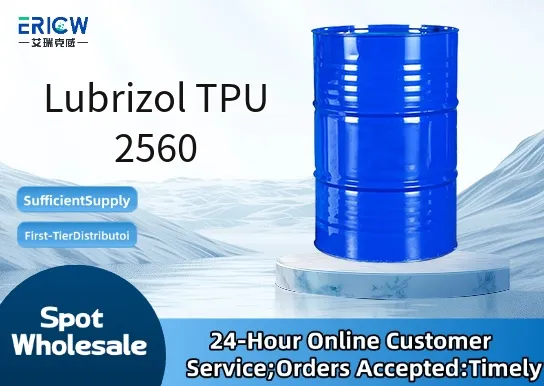
Q1: What is Lubrizol TPU 2560 and how does it differ from standard thermoplastic polyurethanes?
A: Lubrizol TPU 2560 is a high-performance, solution-grade thermoplastic polyurethane specifically engineered for demanding coating, adhesive, and overmolding applications. Unlike many general-purpose TPUs, it offers enhanced solvent resistance, excellent clarity, and superior low-temperature flexibility while maintaining strong substrate adhesion and melt processability.
Q2: Which solvents are compatible with Lubrizol TPU 2560 for solution processing?
A: Lubrizol TPU 2560 demonstrates good solubility in common polar aprotic solvents such as tetrahydrofuran (THF), dimethylformamide (DMF), and methyl ethyl ketone (MEK). Solvent selection should consider end-use requirements—including VOC limitations, drying kinetics, and regulatory compliance—and may require formulation optimization for specific coating or lamination processes.
Q3: Can Lubrizol TPU 2560 be used in medical or food-contact applications?
A: Lubrizol TPU 2560 is not pre-certified for direct food contact or implantable medical use. Its suitability for regulated applications depends on full system evaluation—including compounding additives, processing conditions, and final device testing—by the end-user under applicable regional regulatory frameworks. Lubrizol provides technical support to assist with biocompatibility or extractables assessment planning.
Q4: How does Lubrizol TPU 2560 perform in extrusion and calendering processes?
A: Lubrizol TPU 2560 exhibits excellent melt stability and low extrudate swell, making it well-suited for film extrusion, monolayer and coextrusion, and calendering operations. It typically processes smoothly at conventional TPU temperature profiles, with good surface finish and dimensional stability across a range of line speeds and gauge targets.
Contact With Us:
E-mail: wangxingqiang@ericwchem.com
Have a Questions? Call Us:
Add:
Building A1, Jiete Industrial Park, Huangpu District, Guangzhou City, Guangdong Province, China