English
 Español
 tiếng việt
 русский
High thermal stability up to 1000 °C, suitable for high-temperature ceramic and refractory applications.
Excellent lightfastness and weather resistance, ensuring long-term color retention in outdoor exposure.
Non-toxic, heavy-metal-free formulation compliant with global regulatory standards including EN 71-3 and RoHS.
Superior dispersion stability in aqueous and solvent-based systems, minimizing flocculation and sedimentation.
Consistent particle size distribution for uniform color strength and batch-to-batch reproducibility.
Ceramic glazes and underglaze decorations for tableware and architectural tiles.
High-performance refractory coatings used in metallurgical linings and kiln furniture.
Colorants for concrete pavers, precast concrete elements, and terrazzo flooring.
Pigmentation of specialty plasters, stucco, and mineral-based wall finishes.
Functional coloring agent in fire-resistant building materials and intumescent systems.
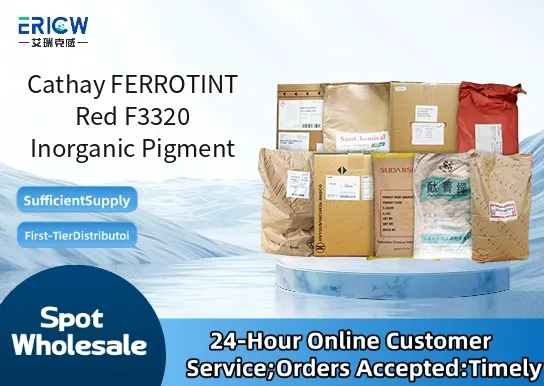
| Chemical Type | Iron oxide-based complex inorganic colored pigment (CICP) |
| Product Form | Fine, free-flowing dry powder |
| Appearance | Brilliant brick-red powder with neutral undertone |
| Primary Applications | Ceramics, refractories, architectural concrete, mineral coatings |
| Key Features | Heat stable, UV resistant, chemically inert, alkali stable |
| Benefits | No bleeding, no migration, low oil absorption, high tinting strength |
| Regulatory Compliance | REACH registered, non-hazardous per GHS, VOC-free |
Q1: What is the primary chemical composition of Cathay FERROTINT Red F3320?
A: Cathay FERROTINT Red F3320 is an inorganic iron oxide-based red pigment, primarily composed of hematite (α-Fe₂O₃), engineered for high thermal stability and consistent chromatic performance in demanding industrial applications.
Q2: Is this pigment suitable for use in food-contact plastics or coatings?
A: While F3320 meets general requirements for low heavy metal content and is widely used in non-food industrial coatings and construction materials, it is not pre-qualified for direct food-contact applications under global regulatory frameworks unless specifically validated by the end-user’s compliance team and supported by full migration testing.
Q3: How does F3320 perform under high-temperature processing conditions?
A: As a thermally stable inorganic oxide pigment, F3320 retains its color integrity and structural stability during standard polymer compounding, extrusion, and baking processes up to approximately 800°C in inert atmospheres — making it suitable for ceramic glazes, high-heat coatings, and engineering thermoplastics.
Q4: Can F3320 be dispersed effectively in water-based systems?
A: Yes — F3320 is compatible with aqueous dispersions when used with appropriate dispersants and pH stabilization. Its surface treatment allows for good wetting and stabilization in architectural paints, cementitious systems, and waterborne industrial coatings, though optimal dispersion requires formulation-specific optimization.
Contact With Us:
E-mail: wangxingqiang@ericwchem.com
Have a Questions? Call Us:
Add:
Building A1, Jiete Industrial Park, Huangpu District, Guangzhou City, Guangdong Province, China