English
 Español
 tiếng việt
 русский
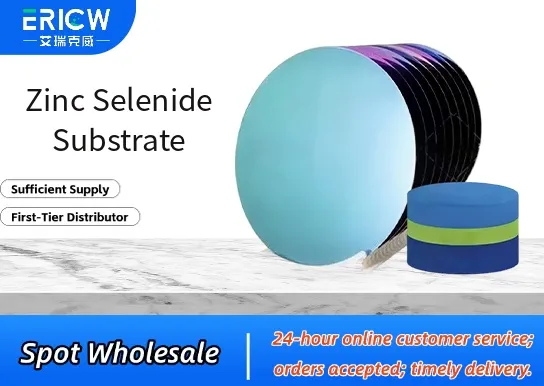
Exceptional infrared transmission from 0.5 to 20 µm, ideal for CO₂ laser optics and thermal imaging systems.
High refractive index (~2.4 at 10.6 µm) enabling efficient anti-reflection coating performance.
Low absorption coefficient in the mid-IR range, supporting high-power laser applications up to 100 W/cm².
Chemically stable under ambient conditions; resistant to moisture and non-oxidizing environments.
Available in precision-polished, double-side polished, or substrate-grade wafers with controlled surface flatness (λ/10 @ 633 nm).
CO₂ laser windows, output couplers, and beam delivery optics for industrial cutting and welding systems.
Lens elements and substrates for FTIR spectrometers and gas analyzers operating in the 2–12 µm spectral region.
Thermal imaging lenses used in uncooled microbolometer-based cameras for defense and surveillance.
Substrates for epitaxial growth of II–VI semiconductor heterostructures in IR optoelectronic research.
Reference standards and calibration components in metrology labs requiring stable IR-transmissive materials.
| Chemical Type | Zinc Selenide (ZnSe), ultra-high purity grade (99.999% min) |
| Product Form | Polished circular wafers, rectangular plates, or custom-shaped substrates |
| Appearance | Translucent orange-yellow to pale amber, optically homogeneous, bubble-free |
| Melting Point | 1520 °C (under inert atmosphere) |
| Primary Applications | Mid-infrared optics, CO₂ laser components, spectroscopic instrumentation |
| Key Features | High IR transmittance (>70% @ 10.6 µm, 5 mm thickness), low dispersion, isotropic crystalline structure |
| Benefits | Enables high-efficiency laser transmission, reduces thermal lensing, supports broadband AR coatings |
| Regulatory Compliance | RoHS-compliant; conforms to REACH Annex XIV criteria for intentional release |
| Common Compatible Systems | Suitability |
| CO₂ Laser Resonators (e.g., Synrad, Coherent) | Highly Recommended – Optimized for 10.6 µm transmission and thermal load stability |
| FTIR Spectrometers (e.g., Thermo Nicolet iS50, Bruker Vertex 80v) | Highly Recommended – Low scatter, minimal spectral distortion across full mid-IR range |
| Uncooled Thermal Imaging Modules (e.g., FLIR Boson, Seek Thermal) | Recommended – Requires AR coating for optimal NETD; compatible with standard lens mounting interfaces |
| Physical Vapor Deposition (PVD) Coating Systems | Suitable – Stable under high-vacuum conditions; accepts dielectric AR/HR coatings without interfacial delamination |
Q1: What is the CAS Number for Zinc Selenide?
A: The CAS Registry Number for Zinc Selenide is 1315-09-9.
Q2: Is Zinc Selenide subject to leaching or elemental migration under typical optical use conditions?
A: No significant leaching or elemental migration occurs under standard ambient, dry, non-acidic optical operating conditions; ZnSe is not water-soluble and exhibits negligible ion release below pH 5.
Q3: How does ZnSe compare to ZnS (Cleartran®) for CO₂ laser applications?
A: ZnSe offers higher transmission at 10.6 µm (~70% vs. ~65% for ZnS at 5 mm) and lower absorption-induced thermal lensing, making it preferred for high-power continuous-wave CO₂ lasers; ZnS provides greater mechanical hardness and better resistance to abrasion.
Q4: Does your ZnSe substrate meet USP <788> or ISO 10993 requirements for biomedical device use?
A: Standard ZnSe substrates are not certified to USP <788> or ISO 10993; they are intended for industrial and analytical instrumentation only. Biomedical qualification requires additional lot-specific extractables testing and biocompatibility validation.
Contact With Us:
E-mail: wangxingqiang@ericwchem.com
Have a Questions? Call Us:
Add:
Building A1, Jiete Industrial Park, Huangpu District, Guangzhou City, Guangdong Province, China