English
 Español
 tiếng việt
 русский
Highly selective low-temperature water-gas shift (WGS) catalyst enabling efficient CO conversion at 180–250 °C.
Exceptional sulfur tolerance, maintaining stable activity in feed streams containing up to 10 ppmv H₂S.
Robust thermal and mechanical stability under dynamic process conditions, minimizing attrition and bed settling.
Optimized copper–zinc oxide–alumina formulation with proprietary structural promoters for extended service life.
Pre-sulfided and ready-to-use format, eliminating on-site activation steps and reducing commissioning time.
Low-temperature water-gas shift reactors in ammonia synthesis plants.
Hydrogen production units integrated with steam methane reforming (SMR) and pressure swing adsorption (PSA).
Syngas conditioning for Fischer–Tropsch and methanol synthesis processes.
Carbon capture-ready hydrogen facilities requiring high-purity H₂ with residual CO < 0.2%.
On-purpose hydrogen generation for refineries and petrochemical complexes.
| Chemical Type | CuO–ZnO–Al₂O₃ based low-temperature shift catalyst |
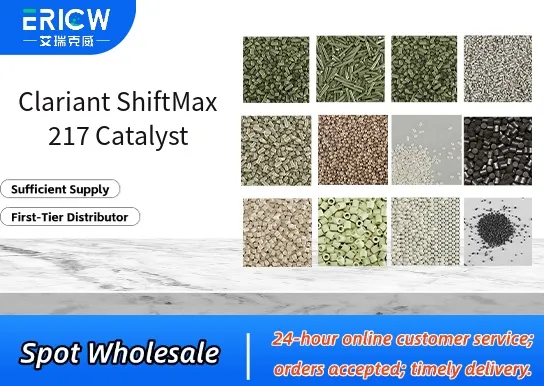
| Product Form | Extrudates (cylindrical pellets, 3–5 mm diameter) |
| Appearance | Gray-black solid granules |
| Primary Applications | Low-temperature water-gas shift (WGS) reaction |
| Key Features | Pre-sulfided, high selectivity, sulfur-tolerant, thermally stable |
| Operating Temperature Range | 180–250 °C |
| Typical Bulk Density | 1.2–1.4 g/cm³ |
| Storage Requirement | Store in dry, ventilated area; protect from moisture and direct sunlight |
Q1: What is the primary function of ShiftMax 217 in polyurethane production?
A: ShiftMax 217 is a high-performance, non-tin catalyst specifically designed to promote the urethane reaction (isocyanate–polyol coupling) while offering excellent selectivity and reduced side reactions such as trimerization or hydrolysis—enabling improved processing control and final foam or elastomer properties.
Q2: Is ShiftMax 217 compatible with common polyurethane formulation components?
A: Yes, ShiftMax 217 demonstrates broad compatibility with conventional polyols (including polyester and polyether types), isocyanates (e.g., MDI and TDI), blowing agents, surfactants, and other auxiliary additives—making it suitable for flexible slabstock, molded foams, and CASE applications.
Q3: How does ShiftMax 217 compare to traditional amine or tin-based catalysts?
A: Unlike many tertiary amines, ShiftMax 217 offers lower volatility and reduced odor impact; compared to stannous octoate, it provides comparable reactivity without the regulatory and handling concerns associated with organotin compounds—supporting more sustainable formulation strategies.
Q4: What is the recommended dosage range for ShiftMax 217?
A: Dosage is formulation-dependent but typically ranges from 0.1% to 2% by weight relative to the polyol component. Optimal levels should be determined through small-scale trials to balance cream time, rise profile, and final physical properties.
Contact With Us:
E-mail: wangxingqiang@ericwchem.com
Have a Questions? Call Us:
Add:
Building A1, Jiete Industrial Park, Huangpu District, Guangzhou City, Guangdong Province, China