English
 Español
 tiếng việt
 русский
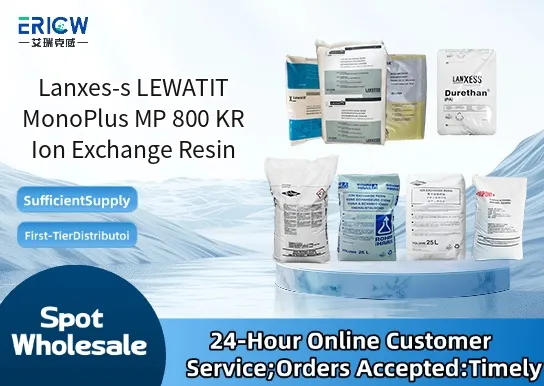
Highly uniform spherical beads ensuring consistent hydraulic performance and low pressure drop.
Optimized macroporous polystyrene-divinylbenzene matrix for superior mechanical strength and chemical stability.
Excellent regeneration efficiency with high selectivity for multivalent cations (e.g., Ca²⁺, Mg²⁺, Fe³⁺).
Designed for robust operation across wide pH range (0–14) and elevated temperatures up to 120 °C.
Low fines generation and minimal attrition during repeated service-regeneration cycles.
Removal of hardness ions in industrial boiler feedwater pretreatment systems.
Recovery and purification of metal ions in hydrometallurgical leach solutions.
Dealkalization and selective cation removal in food & beverage process water.
Pretreatment for reverse osmosis (RO) and electrodeionization (EDI) systems.
Effluent polishing in pharmaceutical and biotech manufacturing wastewater streams.
| Chemical Type | Macroporous strong acid cation exchange resin (sulfonated) |
| Product Form | Moist, spherical beads |
| Appearance | Light to medium amber, opaque beads |
| Functional Group | Sulfonic acid (–SO₃H) |
| Matrix Structure | Polystyrene crosslinked with divinylbenzene (DVB) |
| Ion Form | Hydrogen form (H⁺) |
| Moisture Content | 45–50 % (w/w) |
| Uniformity Coefficient | ≤1.6 |
Q1: What is the primary functional group and ionic form of LEWATIT MonoPlus MP 800 KR?
A: LEWATIT MonoPlus MP 800 KR is a strongly acidic cation exchange resin based on a styrene-divinylbenzene matrix, functionalized with sulfonic acid groups. It is supplied in the potassium (K⁺) ionic form, optimized for selective removal of multivalent cations such as calcium and magnesium in high-purity water applications.
Q2: How does MP 800 KR differ from standard gel-type strong acid cation resins?
A: MP 800 KR belongs to the MonoPlus series, featuring uniform particle size distribution (monodisperse beads), high chemical and osmotic stability, and low pressure drop characteristics. These attributes enhance regeneration efficiency, improve bed homogeneity, and support consistent performance in demanding continuous or batch ion exchange systems—especially where high flow rates or frequent cycling are required.
Q3: Is MP 800 KR suitable for pharmaceutical or food-grade water polishing?
A: Yes—MP 800 KR is manufactured under strict quality control and complies with relevant global pharmacopoeial requirements for ion exchange resins used in purified water and water-for-injection (WFI) systems. It is widely applied in final polishing stages to ensure low conductivity, minimal TOC release, and reliable removal of trace metal ions.
Q4: What regeneration chemicals are recommended for MP 800 KR?
A: The resin is efficiently regenerated using standard strong acid solutions—typically hydrochloric acid (HCl) or sulfuric acid (H₂SO₄). Regeneration concentration, dosage, and contact time should be optimized based on service conditions, but generally follow established protocols for potassium-form strong acid cation resins to maintain capacity and longevity.
Contact With Us:
E-mail: wangxingqiang@ericwchem.com
Have a Questions? Call Us:
Add:
Building A1, Jiete Industrial Park, Huangpu District, Guangzhou City, Guangdong Province, China