English
 Español
 tiếng việt
 русский
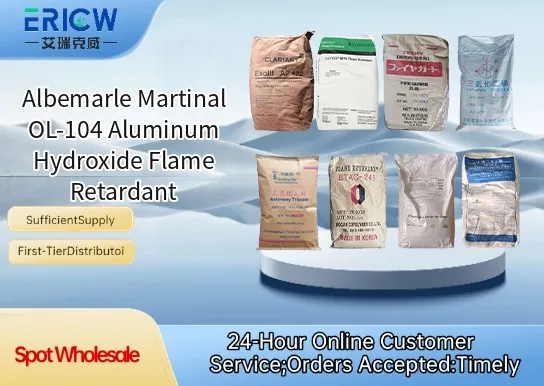
High-purity, surface-treated aluminum hydroxide offering excellent flame retardancy and smoke suppression.
Optimized particle size distribution for improved dispersion in polymer matrices and enhanced mechanical properties.
Low abrasivity, minimizing wear on processing equipment during compounding and extrusion.
Thermally stable up to ~200 °C, supporting processing of engineering thermoplastics without premature decomposition.
Halogen-free and RoHS-compliant, supporting sustainability goals and regulatory requirements for eco-friendly materials.
Flame-retarded polypropylene (PP) for automotive interior components.
Wire and cable jacketing compounds based on low-smoke zero-halogen (LSZH) thermosets and thermoplastics.
Flame-retardant rigid PVC profiles for building and construction applications.
Engineering resin systems including polyethylene (PE) and thermoplastic elastomers (TPE).
Non-halogenated flame-retardant masterbatches for injection-molded consumer electronics housings.
| Chemical Type | Aluminum hydroxide, Al(OH)₃ |
| Product Form | Free-flowing white powder |
| Appearance | White, odorless, non-toxic powder |
| Primary Applications | Halogen-free flame retardant for thermoplastics, thermosets, and elastomers |
| Key Features | Surface-treated with stearic acid for improved polymer compatibility |
| Decomposition Onset Temperature | ~180–200 °C (TGA, 10 °C/min, air) |
| Bulk Density (Loose) | 0.5–0.6 g/cm³ |
| pH (10% aqueous suspension) | 7.5–8.5 |
Q1: What is the primary mechanism by which Martinal OL-104 provides flame retardancy?
A: Martinal OL-104 functions primarily through endothermic decomposition, absorbing heat from the polymer matrix during fire exposure. Upon heating, it releases water vapor, which dilutes flammable gases and cools the combustion zone—contributing to reduced flame spread and smoke generation.
Q2: Is Martinal OL-104 suitable for use in halogen-free flame-retarded formulations?
A: Yes—Martinal OL-104 is an inherently halogen-free, mineral-based flame retardant, making it well-suited for applications requiring compliance with halogen-free specifications, such as certain wire & cable, transportation, and electronics enclosures.
Q3: How does OL-104 compare to other aluminum hydroxide grades in terms of processing stability?
A: OL-104 is surface-treated to enhance compatibility with organic polymers and improve dispersion during compounding. This treatment supports better thermal stability during high-shear extrusion or injection molding, helping to minimize plate-out and maintain consistent rheology in thermoplastic systems.
Q4: Can Martinal OL-104 be used in polyolefin-based compounds?
A: Yes—OL-104 is commonly employed in polypropylene and polyethylene formulations where improved fire performance is required without compromising mechanical properties or processability. Its surface modification facilitates stronger interfacial adhesion and helps retain tensile strength and impact resistance at typical loading levels.
Contact With Us:
E-mail: wangxingqiang@ericwchem.com
Have a Questions? Call Us:
Add:
Building A1, Jiete Industrial Park, Huangpu District, Guangzhou City, Guangdong Province, China