English
 Español
 tiếng việt
 русский
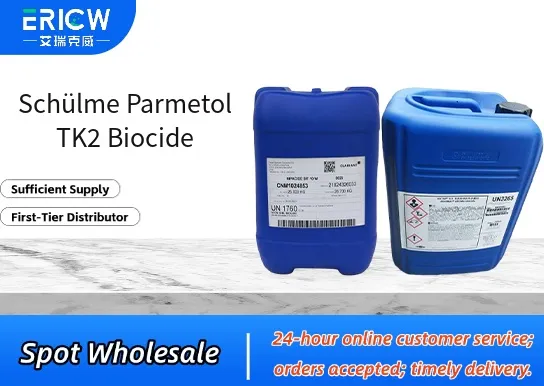
Effective broad-spectrum biocidal activity against bacteria, fungi, and algae.
Stable in high-hardness water and compatible with common industrial water treatment additives.
Low foaming formulation suitable for recirculating cooling water and process water systems.
Non-oxidizing chemistry, minimizing corrosion risk to ferrous and non-ferrous metals.
EPA-registered and compliant with EU BPR (Biocidal Products Regulation) for industrial use.
Cooling water systems in power plants and HVAC installations.
Process water circuits in paper manufacturing and pulp mills.
Recirculating water in metalworking fluid sumps and machining lines.
Industrial wastewater treatment pre-treatment and biofouling control.
Preservation of aqueous-based industrial formulations and intermediates.
| Chemical Type | Isothiazolinone-based biocide blend (active ingredients: 1,2-benzisothiazolin-3-one and 5-chloro-2-methyl-4-isothiazolin-3-one) |
| Product Form | Liquid concentrate |
| Appearance | Clear, pale yellow liquid |
| pH (1% aqueous solution) | 3.0 – 5.0 |
| Density (20 °C) | 1.08 – 1.12 g/cm³ |
| Solubility | Completely miscible with water |
| Storage Stability | ≥24 months in original unopened container at 5–30 °C |
| Primary Applications | Industrial water treatment, metalworking fluids, process water preservation |
Q1: What is the primary mode of action of Schülme Parmetol TK2 Biocide?
A: Schülme Parmetol TK2 Biocide functions as a broad-spectrum preservative through membrane disruption and interference with essential microbial metabolic processes, effectively controlling bacteria, yeasts, and molds in industrial formulations.
Q2: In which types of industrial systems is Parmetol TK2 typically applied?
A: It is commonly used in water-based industrial products such as metalworking fluids, latex paints, adhesives, construction slurries, and cleaning concentrates—particularly where long-term microbiological stability and low volatility are required.
Q3: How should Parmetol TK2 be incorporated into a formulation?
A: It is recommended to add Parmetol TK2 during the cool-down phase or after emulsification, under mild agitation, to ensure uniform dispersion. Pre-dilution in water or a compatible solvent may improve compatibility in sensitive systems.
Q4: Is Parmetol TK2 compatible with common industrial additives?
A: Yes—it demonstrates good compatibility with anionic, nonionic, and cationic surfactants, thickeners, corrosion inhibitors, and most pH stabilizers across a typical working range of pH 5–10. Compatibility testing under actual formulation conditions is always advised.
Q5: What safety and handling considerations apply to Parmetol TK2?
A: As with all biocidal agents, appropriate personal protective equipment (PPE) including gloves and eye protection should be worn during handling. Avoid inhalation of mists or prolonged skin contact. Full safety information is provided in the Safety Data Sheet (SDS), which must be consulted prior to use.
Contact With Us:
E-mail: wangxingqiang@ericwchem.com
Have a Questions? Call Us:
Add:
Building A1, Jiete Industrial Park, Huangpu District, Guangzhou City, Guangdong Province, China