English
 Español
 tiếng việt
 русский
High hydroxyl functionality for excellent crosslink density with multifunctional isocyanates.
Low VOC formulation compatible with 60% solids high-solids coating systems.
Outstanding weathering resistance and UV stability for long-term exterior performance.
Good flow and leveling characteristics enabling smooth, defect-free film formation.
Compatible with common acrylic and polyester polyols in hybrid binder systems.
Automotive OEM clearcoats and basecoat/clearcoat systems.
Industrial maintenance coatings for metal substrates.
General-purpose high-performance coil coatings.
Refinish clearcoats requiring rapid cure and exceptional gloss retention.
| Chemical Type | Hydroxyl-functional acrylic copolymer |
| Product Form | Liquid resin solution |
| Appearance | Clear, colorless to pale yellow liquid |
| Solids Content (wt%) | 60 ± 1% |
| Hydroxyl Value (mg KOH/g) | 95–105 |
| Acid Value (mg KOH/g) | < 5 |
| Viscosity (mPa·s, 25°C, #4 spindle, 20 rpm) | 800–1200 |
| Density (g/cm³, 25°C) | 1.02–1.05 |
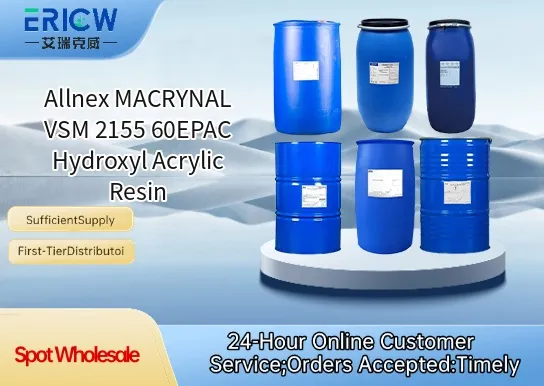
Q1: What is the primary function of MACRYNAL VSM 2155 60EPAC in coating formulations?
A: It serves as a hydroxyl-functional acrylic resin designed to act as a reactive binder in two-component polyurethane and polyester-based crosslinking systems, contributing to film formation, hardness development, and chemical resistance.
Q2: Is MACRYNAL VSM 2155 60EPAC suitable for low-VOC or high-solids applications?
A: Yes — it is formulated to support high-solids coating systems and can be incorporated into low-VOC formulations when paired with appropriate solvents and crosslinkers, helping meet evolving environmental compliance targets without compromising performance.
Q3: How does this resin perform in terms of UV stability and gloss retention?
A: As a purely acrylic hydroxyl resin, it offers inherently good UV resistance and excellent long-term gloss retention, making it well-suited for exterior architectural and industrial maintenance coatings where color and appearance stability are critical.
Q4: What types of crosslinkers are typically used with MACRYNAL VSM 2155 60EPAC?
A: It is commonly paired with aliphatic isocyanate crosslinkers (e.g., HDI-based polyisocyanates) for high-performance topcoats, and may also be used with melamine-formaldehyde resins in thermoset baking systems, depending on cure conditions and end-use requirements.
Contact With Us:
E-mail: wangxingqiang@ericwchem.com
Have a Questions? Call Us:
Add:
Building A1, Jiete Industrial Park, Huangpu District, Guangzhou City, Guangdong Province, China