English
 Español
 tiếng việt
 русский
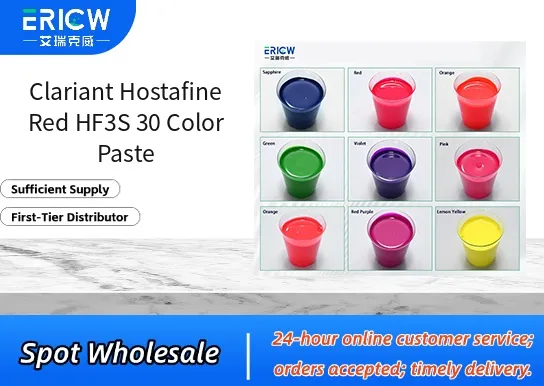
High chroma, clean red shade with excellent color strength and batch-to-batch consistency.
Optimized for high-solids, low-VOC industrial coatings systems including waterborne and solventborne formulations.
Outstanding dispersion stability and compatibility with common acrylic, polyester, and alkyd resin systems.
Good lightfastness and thermal stability up to 180 °C (short-term exposure).
Free of heavy metals, APEOs, and restricted aromatic amines — compliant with major global regulatory frameworks.
Automotive OEM and refinish coatings.
Industrial maintenance and coil coatings.
General-purpose decorative architectural paints.
Plastic coloration for exterior-grade thermoplastics (e.g., PP, ABS).
Printing inks for packaging and industrial labeling.
| Chemical Type | Organic pigment dispersion (quinacridone-based) |
| Product Form | Liquid color paste (aqueous/solvent hybrid vehicle) |
| Appearance | Homogeneous, viscous red paste |
| Primary Applications | Industrial coatings, automotive finishes, plastics, printing inks |
| Key Features | High tinting strength, excellent dispersibility, low foam generation |
| Benefits | Reduced formulation time, improved color accuracy, enhanced storage stability |
| Recommended Storage | 15–25 °C; protect from freezing and direct sunlight |
| Shelf Life | 24 months in unopened original container under recommended conditions |
Q1: What is the primary application area for Hostafine Red HF3S 30?
A: Hostafine Red HF3S 30 is specifically developed for high-performance coloring of thermoplastic polymers, especially polyolefins (PP, PE) and engineering plastics such as ABS and PS, where excellent heat stability, dispersion, and color strength are required.
Q2: How should this color paste be incorporated into polymer melts?
A: It is typically added directly to the polymer melt during extrusion or injection molding using standard gravimetric or volumetric dosing equipment. Good pre-mixing with carrier resin or masterbatch dilution is recommended to ensure uniform dispersion.
Q3: Is Hostafine Red HF3S 30 suitable for food-contact applications?
A: This product is formulated without heavy metals and complies with general requirements for food-contact plastics under major global regulatory frameworks; however, final compliance depends on the complete formulation, processing conditions, and applicable regional regulations — users must conduct their own verification.
Q4: What is the typical dosage range for achieving strong red shades?
A: Dosage generally ranges from 0.1% to 2% by weight depending on the base polymer, desired shade intensity, and processing method — it is typically used at low concentrations due to its high tinctorial strength and efficient dispersion.
Q5: Does this paste require special storage or handling precautions?
A: Store in a cool, dry place away from direct sunlight and extreme temperatures. Keep containers tightly sealed to prevent moisture uptake and avoid contamination. Standard industrial hygiene practices for handling organic pigments apply.
Contact With Us:
E-mail: wangxingqiang@ericwchem.com
Have a Questions? Call Us:
Add:
Building A1, Jiete Industrial Park, Huangpu District, Guangzhou City, Guangdong Province, China