English
 Español
 tiếng việt
 русский
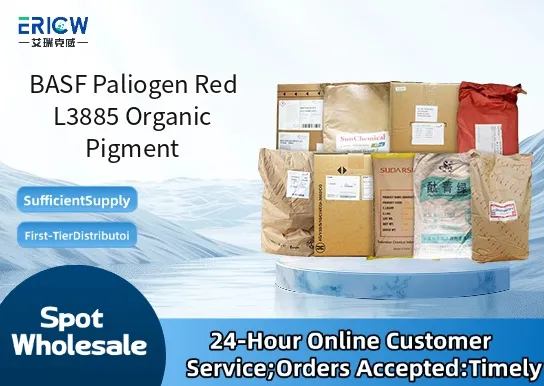
High thermal stability suitable for demanding processing conditions up to 300 °C.
Excellent lightfastness and weather resistance (Xenon arc fadeometer rating ≥7 on Blue Scale).
Outstanding chemical resistance to acids, alkalis, and solvents commonly used in industrial coatings.
Strong tinctorial strength with clean, bluish-red shade and high chroma.
Low volatility and negligible migration in polymer matrices, ensuring long-term color integrity.
Automotive OEM and refinish coatings requiring high durability and color consistency.
Engineering plastics including polyamide (PA), polybutylene terephthalate (PBT), and polycarbonate (PC).
High-performance powder coatings for architectural and industrial metal substrates.
Specialty inks for flexible packaging and gravure printing on laminated films.
Masterbatches for thermoplastic elastomers (TPE) and flame-retardant compounds.
| Chemical Type | Perylene derivative (C.I. Pigment Red 149) |
| Product Form | Fine, free-flowing powder |
| Appearance | Deep bluish-red powder |
| Primary Applications | Coatings, engineering plastics, powder coatings, specialty inks |
| Key Features | Thermal stability, lightfastness, chemical resistance, low migration |
| Benefits | Color consistency in high-heat processing, outdoor durability, compatibility with polar polymers |
| Particle Size (D50) | 0.08–0.12 µm (by laser diffraction) |
| Volatile Matter (105 °C, 2 h) | ≤0.5 wt% |
Q1: What are the key performance advantages of Paliogen Red L3885 compared to conventional red organic pigments?
A: Paliogen Red L3885 offers exceptional thermal stability and outstanding lightfastness, making it particularly suitable for high-temperature processing applications such as engineering plastics and powder coatings. Its robust molecular structure also provides superior resistance to migration and blooming in demanding polymer matrices.
Q2: Is Paliogen Red L3885 suitable for use in food-contact plastics?
A: While Paliogen Red L3885 is not pre-approved for direct food-contact applications under major global regulatory frameworks, it may be considered for indirect food-contact uses—such as packaging layers with functional barriers—subject to full formulation evaluation and compliance verification by the end-user’s regulatory team.
Q3: How does Paliogen Red L3885 perform in high-gloss automotive basecoats?
A: This pigment delivers excellent chroma and transparency in solvent-borne and high-solids automotive basecoats, supporting vibrant metallic and pearlescent effects. Its fine particle size distribution and surface treatment promote good dispersion stability and minimal filter clogging during spray application.
Q4: What is the typical dosage range when using Paliogen Red L3885 in polyolefin masterbatches?
A: Dosage generally ranges from 0.1% to 2% by weight depending on the desired shade intensity and substrate opacity, with optimal results typically achieved at low-to-moderate concentrations due to its high tinctorial strength and efficient dispersion behavior in PP and PE systems.
Contact With Us:
E-mail: wangxingqiang@ericwchem.com
Have a Questions? Call Us:
Add:
Building A1, Jiete Industrial Park, Huangpu District, Guangzhou City, Guangdong Province, China