English
 Español
 tiếng việt
 русский
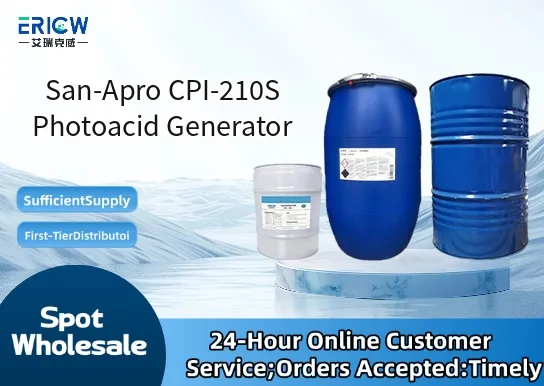
High quantum yield for efficient acid generation under 365 nm (i-line) and 248 nm (KrF) exposure.
Excellent thermal stability—no premature acid release below 120 °C during pre-bake or storage.
Low volatility and minimal outgassing, supporting high-resolution lithographic processes in vacuum environments.
Compatible with standard alkaline-developable positive-tone resists based on poly(p-hydroxystyrene) and its derivatives.
Consistent batch-to-batch performance with strict QC control per ISO 9001 manufacturing protocols.
Advanced semiconductor photolithography for logic and memory device fabrication (130–65 nm nodes).
Microelectromechanical systems (MEMS) patterning requiring high aspect-ratio resist profiles.
Flexible printed electronics, including fine-line silver nanoparticle and conductive polymer patterning.
Wafer-level packaging (WLP) and redistribution layer (RDL) photopatterning using thick-film resists.
Optical waveguide and diffractive optical element (DOE) fabrication in SiO₂ and polymer substrates.
| Chemical Type | Sulfonium salt (triphenylsulfonium nonaflate derivative) |
| Product Form | White to off-white crystalline powder |
| Appearance | Free-flowing, homogeneous crystalline solid |
| Melting Point | 178–182 °C (DSC, onset) |
| Primary Applications | i-line (365 nm), KrF (248 nm), and broad-band UV photoresist systems |
| Key Features | High acid strength (H₀ ≈ –12), low diffusion coefficient in film, rapid post-exposure bake (PEB) response |
| Benefits | Enables high sensitivity (≤10 mJ/cm²), improved line-edge roughness (LER), and reduced standing-wave effects |
| Regulatory Compliance | REACH SVHC-free; RoHS 3 compliant; no intentionally added PFAS |
| Common Compatible Systems | Suitability |
| JSR TMMR series (e.g., TMMR-P1000) | Highly Recommended – Optimized PAG loading and dissolution contrast demonstrated |
| Shin-Etsu SPR series (e.g., SPR220/7) | Recommended – Requires minor formulation adjustment for optimal sensitivity |
| Sumitomo Chemical UV-119/UV-120 resists | Suitable – Validated for i-line applications; extended PEB window required |
| DOW DUV-3000 resin platform | Highly Recommended – Excellent compatibility with acetal-based chemically amplified resists |
Q1: What is the CAS Registry Number for San-Apro CPI-210S?
A: The CAS number is 1821925-43-0. This identifier corresponds specifically to the triphenylsulfonium nonaflate derivative used in CPI-210S.
Q2: What is the recommended loading level in a typical chemically amplified resist formulation?
A: Standard loading ranges from 1.5 to 4.0 wt% relative to the solid content of the resist. Optimal performance is typically achieved at 2.5–3.0 wt% for i-line applications and 2.0–2.8 wt% for KrF systems.
Q3: How does CPI-210S compare to CPI-101A or UVACURE 1500 in terms of acid diffusion and resolution?
A: CPI-210S exhibits lower acid diffusivity (Dacid ≈ 0.012 µm²/s at 110 °C) than CPI-101A (≈0.021 µm²/s), enabling finer resolution and reduced LER. Compared to UVACURE 1500, it offers higher thermal latency and superior shelf-life stability.
Q4: Is CPI-210S compliant with food contact or medical device regulations?
A: CPI-210S is not intended for direct food contact or implantable medical devices. It is approved for use in semiconductor manufacturing where final devices undergo full cleaning and passivation; no migration testing data is available for ISO 10993 or FDA 21 CFR 175.300 applications.
Contact With Us:
E-mail: wangxingqiang@ericwchem.com
Have a Questions? Call Us:
Add:
Building A1, Jiete Industrial Park, Huangpu District, Guangzhou City, Guangdong Province, China