English
 Español
 tiếng việt
 русский
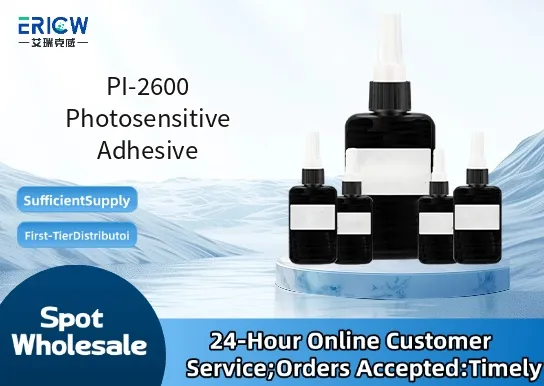
High-resolution photopatternability with sub-15 µm feature definition under standard UV exposure (i-line, 365 nm).
Excellent thermal stability up to 250 °C for extended post-bake and subsequent high-temperature processing.
Low outgassing profile compatible with vacuum-based semiconductor and MEMS fabrication environments.
Single-layer formulation enabling direct develop-and-etch without lift-off or additional masking steps.
Chemically resistant to common etchants including CF₄/O₂ plasma, diluted HF, and TMAH (2.38%).
Temporary bonding and debonding layers in silicon interposer and fan-out wafer-level packaging (FOWLP).
Photodefined stress-relief adhesives for micro-optical component assembly (e.g., VCSEL arrays, lens modules).
Patterning layer for microfluidic channel definition on glass, quartz, and low-α silica substrates.
Die attach adhesive in high-reliability automotive sensor modules requiring reflow compatibility.
UV-curable release layer in temporary carrier systems for ultra-thin die handling (< 50 µm).
| Chemical Type | Photosensitive polyimide precursor (negative-tone) |
| Product Form | Ready-to-use viscous liquid (solvent-based) |
| Appearance | Amber-transparent, homogeneous solution |
| Viscosity (25 °C, Brookfield RV) | 1,800 – 2,200 cP |
| Primary Applications | Temporary bonding, photopatterned dielectric, release layer |
| Key Features | UV-sensitive, thermally imidizable, non-corrosive residue |
| Benefits | Process simplification, high alignment accuracy, low thermal budget curing |
| Regulatory Compliance | REACH SVHC-free; RoHS 2015/863 compliant; no intentional PFAS |
| Common Compatible Systems | Suitability |
| EVG® GEMINI® FB Hybrid Bonding System | Highly Recommended – Validated for full process integration including alignment, bond, and thermal debond |
| Canon FPA-5550 i-Z Lithography Stepper | Recommended – Optimized for i-line exposure; resolution confirmed at 12 µm L/S |
| Screen PAC300 Spin Coater & Bake Platform | Highly Recommended – Pre-validated coating parameters (3,000 rpm, 30 s) and soft-bake profile |
| Modutek SST-200 Spray Developer | Suitable – Compatible with aqueous TMAH-based development; adjustable spray pressure recommended |
Q1: What is the CAS Registry Number for PI-2600?
A: The CAS Registry Number for PI-2600 Photosensitive Adhesive is 2279572-88-4 (for the proprietary photosensitive resin blend); individual monomer CAS numbers are available upon NDA execution.
Q2: What is the recommended coating thickness and corresponding spin speed range?
A: Target dry-film thickness is 8–12 µm; typical spin coating uses 2,500–3,200 rpm for 30 seconds on 200 mm wafers, followed by a 90 °C soft bake for 90 seconds.
Q3: How does PI-2600 compare to conventional non-photosensitive polyimide adhesives like PI-2525?
A: Unlike PI-2525, PI-2600 eliminates separate photomask and etch steps—enabling direct patterning with <50 nm overlay accuracy and reducing process cycle time by ~40% in temporary bonding applications.
Q4: Is PI-2600 certified for use in food-contact or medical device manufacturing?
A: PI-2600 is not certified for direct food-contact or implantable medical devices; however, it meets ISO 10993-5 (cytotoxicity) and USP <87> extractables testing for Class VI plastics when fully cured and post-processed per datasheet protocol.
Q5: Does PI-2600 exhibit migration or small-molecule extraction under thermal stress?
A: Extraction studies (per ICH Q5C) show <0.1 ppm volatile organic residue after full imidization (250 °C/1 h in N₂), with no detectable leachables in aqueous or isopropanol simulants at 60 °C for 72 h.
Contact With Us:
E-mail: wangxingqiang@ericwchem.com
Have a Questions? Call Us:
Add:
Building A1, Jiete Industrial Park, Huangpu District, Guangzhou City, Guangdong Province, China