English
 Español
 tiếng việt
 русский
Broad-spectrum activity against key foliar and soil-borne fungal pathogens including Rhizoctonia, Fusarium, and Pythium species.
Systemic and protective mode of action with translaminar movement for extended residual control.
Low-use-rate formulation enabling efficient application and reduced environmental loading.
Compatible with major adjuvants and commonly used fungicides for flexible tank-mix programs.
Designed for use in integrated pest management (IPM) strategies with favorable toxicological and ecotoxicological profile.
Preventive and curative treatment in greenhouse-grown ornamentals and bedding plants.
Seedling protection in nursery production of conifers and broadleaf trees.
Foliar spray program for high-value vegetable crops including tomato, cucumber, and pepper.
Soil drench application for disease suppression in containerized horticultural crops.
Management of damping-off and root rot in commercial turfgrass sod production.
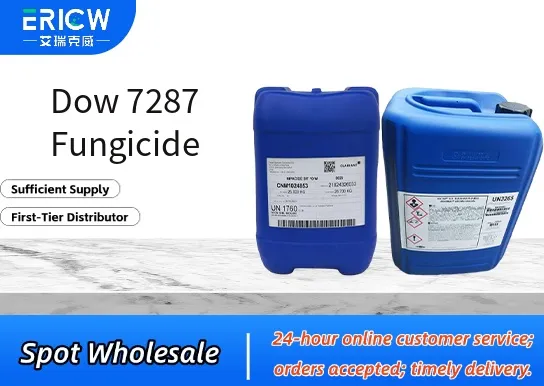
| Chemical Type | Strobilurin-class fungicide (active ingredient: Trifloxystrobin) |
| Product Form | Flowable suspension concentrate (FS) |
| Appearance | Off-white to light tan suspension |
| Primary Applications | Foliar spray, soil drench, chemigation |
| Key Features | Systemic + protective; rainfast within 2 hours |
| Benefits | Flexible timing, resistance management support, low phytotoxicity risk |
| Storage Conditions | Store between 5°C and 30°C; protect from freezing and direct sunlight |
| Shelf Life | 24 months from date of manufacture under recommended storage |
Q1: What is the primary mode of action of Dow 7287 Fungicide?
A: Dow 7287 Fungicide functions as a broad-spectrum protective and curative fungicide, primarily inhibiting fungal cell membrane synthesis through disruption of ergosterol biosynthesis. Its chemical structure supports systemic activity in certain formulations, enabling both local and translaminar movement within treated substrates.
Q2: In which types of industrial applications is Dow 7287 Fungicide commonly formulated?
A: It is widely incorporated into water-based industrial coatings, adhesives, sealants, construction materials, and polymer emulsions where long-term resistance to mold, mildew, and saprophytic fungi is required. It is especially valued in high-humidity or outdoor-exposed applications where microbial degradation poses a performance risk.
Q3: Is Dow 7287 Fungicide compatible with common co-biocides and formulation additives?
A: Yes — Dow 7287 Fungicide demonstrates good compatibility with many isothiazolinones, benzisothiazolinones, and triazole-based co-biocides, as well as typical surfactants, thickeners, and pH stabilizers used in aqueous systems. Compatibility testing under actual formulation conditions is recommended prior to full-scale production.
Q4: What is the typical dosage range for effective fungal control in industrial formulations?
A: Effective dosage generally ranges from 0.1% to 2% by weight of the final formulation, depending on the substrate, expected environmental exposure, and target spectrum. It is typically used at low concentrations due to its high intrinsic activity and stability in complex matrices.
Contact With Us:
E-mail: wangxingqiang@ericwchem.com
Have a Questions? Call Us:
Add:
Building A1, Jiete Industrial Park, Huangpu District, Guangzhou City, Guangdong Province, China