English
 Español
 tiếng việt
 русский
Systemic and protective activity against a broad spectrum of ascomycete and basidiomycete pathogens.
Optimized for curative action with strong translaminar movement and moderate xylem mobility.
Low phytotoxicity profile on sensitive crops when applied at recommended rates.
Compatible with major adjuvants and commonly used insecticides and growth regulators.
Designed for resistance management within FRAC Group 3 (DMI fungicides) rotation programs.
Wheat and barley for control of powdery mildew, leaf rust, and septoria leaf blotch.
Rice cultivation targeting sheath blight and false smut under high-humidity conditions.
Soybean fields managing frogeye leaf spot and target spot caused by Cercospora spp.
Oilseed rape (canola) to suppress sclerotinia stem rot and light leaf spot.
Orchard crops including apple and pear for suppression of scab and brown rot.
| Chemical Type | Triazole-based systemic fungicide (active ingredient: Metconazole) |
| Product Form | Emulsifiable concentrate (EC) |
| Appearance | Amber to light brown clear liquid |
| Active Ingredient Concentration | 250 g/L Metconazole |
| pH Range (1% aqueous solution) | 6.0 – 7.5 |
| Density (20°C) | 1.08 – 1.12 g/cm³ |
| Storage Stability | ≥ 24 months in original unopened container at ≤ 30°C |
| Primary Applications | Cereals, rice, soybean, oilseed rape, pome fruit, stone fruit |
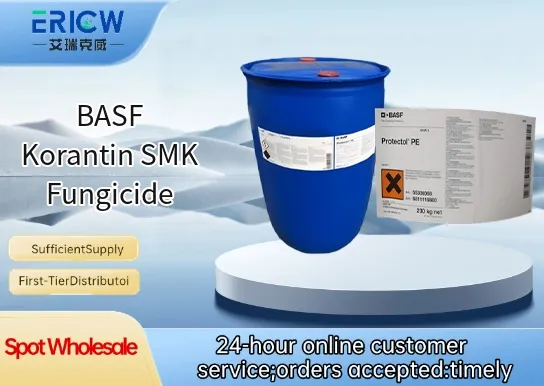
Q1: What is the primary mode of action of Korantin SMK?
A: Korantin SMK is a broad-spectrum fungicide with multi-site contact activity, primarily inhibiting fungal spore germination and mycelial growth through disruption of cellular membrane integrity and energy metabolism.
Q2: Which crop protection applications is Korantin SMK typically formulated for?
A: It is commonly incorporated into suspension concentrates (SC), wettable powders (WP), and granular formulations for use in field crops, vegetables, and ornamentals—especially where resistance management and rapid knockdown are priorities.
Q3: Is Korantin SMK compatible with common adjuvants and other agrochemical actives?
A: Yes, Korantin SMK demonstrates good physical and chemical compatibility with many widely used surfactants, spreaders, and broad-spectrum fungicides or insecticides—though tank-mix compatibility should always be verified under actual formulation conditions prior to commercial use.
Q4: What safety and handling considerations apply during industrial formulation?
A: As with all active ingredients, appropriate engineering controls (e.g., local exhaust ventilation), personal protective equipment (PPE), and adherence to BASF’s Safety Data Sheet (SDS) are essential. Korantin SMK is not classified as highly toxic but requires standard occupational hygiene practices for dust and aerosol exposure control.
Contact With Us:
E-mail: wangxingqiang@ericwchem.com
Have a Questions? Call Us:
Add:
Building A1, Jiete Industrial Park, Huangpu District, Guangzhou City, Guangdong Province, China