English
 Español
 tiếng việt
 русский
Broad-spectrum antimicrobial activity against bacteria, fungi, and yeasts.
Stable in water-based systems with excellent compatibility across a wide pH range (pH 4–10).
Low volatility and low odor profile, supporting safer handling and reduced worker exposure.
Effective at low use concentrations, offering cost-efficient preservation.
Non-oxidizing mode of action, minimizing risk of material degradation in sensitive formulations.
Water-based architectural paints and coatings.
Industrial maintenance coatings and coil coatings.
Adhesives, sealants, and construction mastics.
Printing inks and pigment dispersions.
Wood preservatives and aqueous wood treatment formulations.
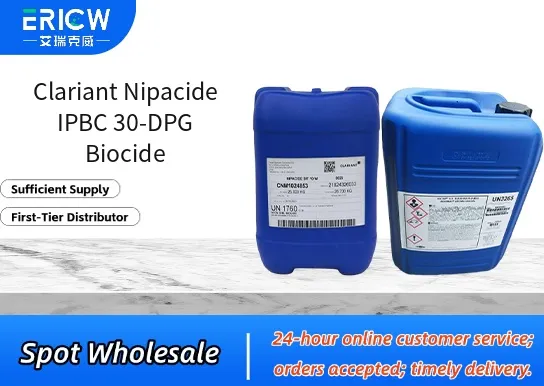
| Chemical Type | Iodopropynyl butylcarbamate (IPBC) |
| Product Form | Liquid solution |
| Appearance | Clear to slightly hazy, pale yellow liquid |
| Active Ingredient Content | 30% w/w IPBC |
| Solvent System | Dipropylene glycol (DPG) |
| Density (20 °C) | Approx. 1.08–1.12 g/cm³ |
| Flash Point (Closed Cup) | Approx. 125 °C |
| pH (1% aqueous solution) | 5.0–7.0 |
Q1: What is the primary active ingredient in Nipacide IPBC 30-DPG Biocide?
A: The active biocidal component is iodopropynyl butylcarbamate (IPBC), formulated in a 30% aqueous solution with dipropylene glycol (DPG) as a stabilizing and solubilizing carrier.
Q2: In which types of industrial formulations is this biocide commonly applied?
A: It is widely used in water-based coatings, adhesives, sealants, construction mortars, and industrial cleaning products where broad-spectrum protection against bacteria, yeasts, and molds is required during storage and in the dried film.
Q3: Is Nipacide IPBC 30-DPG compatible with common preservative systems or co-biocides?
A: Yes, it is frequently combined with isothiazolinones or benzisothiazolinone to enhance spectrum and performance, particularly in challenging formulations; compatibility should be verified experimentally for each specific system.
Q4: How should this biocide be handled and stored to maintain stability and efficacy?
A: Store in tightly sealed original containers at temperatures between 5 °C and 30 °C, protected from direct sunlight and freezing; avoid prolonged exposure to high pH or strong oxidizing agents to prevent degradation.
Contact With Us:
E-mail: wangxingqiang@ericwchem.com
Have a Questions? Call Us:
Add:
Building A1, Jiete Industrial Park, Huangpu District, Guangzhou City, Guangdong Province, China