English
 Español
 tiếng việt
 русский
Excellent soft-touch feel with balanced elasticity and compression set resistance
Good processability via injection molding and extrusion without pre-drying
Enhanced compatibility with polypropylene (PP) and polyethylene (PE) substrates
Low extractables and compliant with FDA 21 CFR §177.2600 for food-contact applications
Halogen-free formulation meeting RoHS and REACH regulatory requirements
Overmolding for automotive interior trim components
Soft-grip handles for power tools and consumer appliances
Sealing gaskets and flexible caps in packaging systems
Medical device grips and non-critical housings
Consumer electronics casings requiring tactile comfort and durability
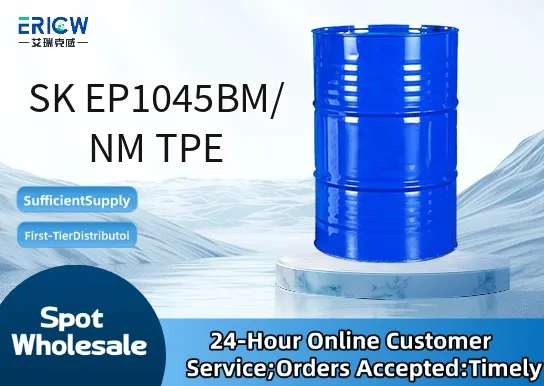
| Chemical Type | Thermoplastic Elastomer (TPE), SEBS-based |
| Product Form | Pellets |
| Appearance | Off-white to light beige, free-flowing granules |
| Hardness (Shore A) | 45 ± 3 |
| Melt Flow Rate (230°C/2.16 kg) | 18–22 g/10 min |
| Density | 0.90–0.92 g/cm³ |
| Key Features | Soft-touch, PP/PE adhesion, low odor, recyclable |
| Primary Applications | Overmolding, soft grips, seals, consumer product components |
Q1: What is the primary functional role of SK EP1045BM/NM TPE in thermoplastic elastomer formulations?
A: SK EP1045BM/NM TPE is a specialized processing aid and compatibilizer designed to enhance melt flow, reduce viscosity, and improve phase dispersion in multi-component TPE systems—particularly those incorporating polyolefin-based matrices and polar elastomers such as SEBS or TPU.
Q2: Is SK EP1045BM/NM TPE suitable for food-contact or medical-grade applications?
A: While SK EP1045BM/NM TPE is formulated with high-purity raw materials and low volatility, it is not pre-qualified for regulated food-contact or medical applications. End-use compliance requires full formulation-level testing and validation by the compounder or end-user against applicable regional regulatory frameworks.
Q3: How should SK EP1045BM/NM TPE be incorporated into a TPE compound during processing?
A: It is typically introduced during the masterbatch stage or final compounding step via gravimetric feeding. For optimal dispersion, it is recommended to add after polymer melting has initiated and before final homogenization—especially when used alongside fillers or reinforcing agents.
Q4: Does SK EP1045BM/NM TPE affect the mechanical properties of the final TPE compound?
A: At typical use levels, it generally maintains or slightly improves tensile strength and elongation retention—especially in shear-sensitive formulations—by promoting finer phase morphology and reducing interfacial tension. Significant over-addition may lead to softening or reduced modulus, so dosage should be optimized per application requirements.
Contact With Us:
E-mail: wangxingqiang@ericwchem.com
Have a Questions? Call Us:
Add:
Building A1, Jiete Industrial Park, Huangpu District, Guangzhou City, Guangdong Province, China